Easy, breezy, accessible science

Guest post by mèþru:
I found this video about the misreporting of science in order to make it interesting for wide audiences. Comedian John Oliver discusses how reporters do not fact check the studies they report, make sweeping conclusions that barely resemble the content of the studies, and talk about science in a way that amounts to misinformation.

Posted in academia, humor | Tagged , , , , , | Leave a comment

Engineering Characters

“Miss Havisham had told me about Generics. They were created here in the Well to populate the books that were to be written. At the point of creation they were simply a human canvas without paint – blank like a coin, ready to be stamped with individualism. They had no history, no conflicts, no foibles – nothing that might make them either readable or interesting in any way. It was up to various institutions to teach them to be useful members of fiction . They were graded, too. A to D, one through ten. Any that were D-graded were like worker bees in crowds and busy street. Small speaking parts were C-grades; B-grades usually made up the bulk of featured but not leading characters. These parts usually – but not always – went to the A-grades, hand picked for their skills at character projection and multi-dimensionality. Huckleberry Finn, Tess and Anna Karenina were all A-grades, but then so were Mr Hyde, Hannibal Lecter and Professor Moriarty. I looked at the ungraded Generics again. Murderers or heroes? It was impossible to tell how they would turn out.”
from The Well of Lost Plots, by Jasper Fforde

So, how does one create enduring protagonists – is it a matter of craft? When a local library offered a workshop on “twists and turns of writing character,” I came to find out how to craft memorable, believable characters. Here is what I’ve learned:

  1. A character must want something. It can be a need, desire, ambition or goal. The stronger it is, the better it can propel the character to act. Since the world (and other characters) might have different goals, a character’s wants create conflict (the bread-and-butter of every story).
  2. A character must have some fundamental fear that he keeps in secret, which makes him vulnerable. The secret can be manifested as a trait, as a pivotal event from character’s past, or whatsoever as long as it sustains tension and raises the stakes.
  3. A complex character will have contradicting traits and flaws. Complexity of character leads to unpredictable reactions (especially at times of trial). Since reaction is usually followed by action, the chain of actions and reactions move the story forward. Unpredictable reactions give rise to suspense, through increasing the readers’ engagement (they keep wondering what will happen next).
  4. Genre demands. Physical appearance, age, and even some character traits arise from expectations specific to a genre. A world-weary, alcohol-abusing fat man in his fifties can be a great protagonist in a crime novel, but he is a very unlikely candidate to be the leading man in a contemporary romance.
  5. Character names matter. Since I don’t remember the examples from the workshop, here is one from Harry Potter and the Philosopher’s Stone: “Albus Dumbledore didn’t seem to realise that he had just arrived in a street where everything from his name to his boots was unwelcome.” Can anyone imagine a Hogwarts headmaster with a name like Jack or Steve?
  6. A hero of a story does not have to be larger-than-life. He can be an ordinary guy, but one who is able to rise to an occasion in unusual circumstances. Most people who have read O. Henry’s “A Retrieved Reformation” remember Jimmy Valentine with some tenderness, although they don’t particularly aspire to become a reformed criminal.
  7. Instead of using stereotypical “stock characters,” a writer can draw from real-life people she knows (family members, neighbors, co-workers…). Composite (and unrecognizable) characters can be assembled from bits and pieces of real people. The real challenge is to create characters that will become real to the writer, so real that she’ll feel her characters take initiative to roll their own story.
  8. There is no trusty recipe of how to create an “A-grade” character. Despite all the “craft” that can be learned, writing fiction is more Art than Science.


Posted in fiction, literature, writing | Tagged , , , , , , | Leave a comment

Double Rainbow

rainbow

Yesterday we saw a beautiful double rainbow. It hovered in the gray sky, two full arcs glowing with iridescent colors. The photos captured some of the splendor that we saw. Continue reading →

Posted in photos | Tagged , , , | Leave a comment

Talking cosmology at a party

“…I barely know her, but if I were you, I would not mention cosmology.”
Jon’s advice was not surprising. Danielle did not mention what she was studying when the likely responses were astonished stares, ill-fitted jokes, and awkward silences before someone said that she must be very smart. Cosmology, experience had taught her and Jonathan, was not a profession one flaunts in a social gathering. It drew embarrassingly little interest, unless someone confused it with cosmetology.”
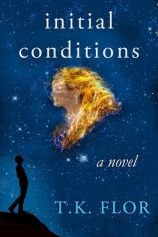
From Initial Conditions

A man I had briefly met once or twice before approached me at a party. He had heard that I published a book about physicists and wanted to know what qualifications I had to write about the subject. Apparently satisfied with my academic credentials, he shifted the conversation to cosmology. Going over all his remarks is way too long for the blog, but I think that the following three misconceptions are worth repeating and rebutting. Continue reading →

Posted in academia, cosmology, physics | Tagged , , , , , , | 4 Comments

Sophomore novel – trying to recapture first love, or finding a second one?

“The problem with a second novel is that it takes almost no time to write compared with a first novel. If I write my first novel in a month at the age of 23 and my second novel takes me two years, which one have I written more quickly? The second, of course. The first took 23 years and contains all the experience, pain, stored-up artistry, anger, love, hope, comic invention and despair of a lifetime. The second is an act of professional writing. That is why it is so much more difficult.”
Stephen Fry, at the inaugural awarding of the Encore Prize, established to honor writers who successfully navigate the peculiar perils of the second novel. Quoted by themillions.com

It is often said that most people (about 80 percent of Americans) feel that they have a book in them. But did anyone check how many feel that they have MORE than a single book in them? Is writing more than one novel what separates laymen with literary aspirations from professionals? Continue reading →

Posted in fiction, literature, self-publishing, writing | Tagged , , , , | Leave a comment

Tourism and fiction

“Japan’s smallest prefecture is aiming to attract more Thai tourists by sponsoring a series of romance novels set in the region.
The southern Kagawa Prefecture has teamed up with four Thai writers for the initiative, who have each penned love stories inspired by their travels around the area, the Kyodo news agency reports. The series has been named Kagawa, Let Love Lead, and was launched at Thailand’s National Book Fair in Bangkok.”
From BBC

Tourists following books are not a new phenomenon. People need to recharge, go away from their daily routine. They can travel to places, or “visit” them through literature, or both.

“The urge to get away, to travel, blends the phenomenon of escapism into the world of fiction. For literary tourists the primal source of escapism comes from the novels they read, inciting the desire to visit the place mentioned in the books. Thus, the ‘derived escapism’ transcends from literature into tourism. The illusion of the fictional world is perpetuated into the real locations used to attract avid readers and cinema buffs alike.”
(from Journeys Beyond Pages: The Use of Fiction in Tourism)

Continue reading →

Posted in contemporary romance, fiction, humor, literature | Tagged , , , , , | Leave a comment

Money-laundering – confessions in view of the Panama Papers

Note: This blog-post was written by a guest-blogger who prefers to remain anonymous (read below and you will see why).

It seems that the Panama papers have taken the world by a storm: Continue reading →

Posted in humor | Tagged , , , , , , , , , | Leave a comment

Perceptions of brilliance

Little Prince's Rose at the Museum of The Little Prince in Hakone, Japan

“On the little prince’s planet the flowers had always been simple. They had only one ring of petals; they took up no room at all; they were trouble to nobody. One morning they would appear in the grass, and by night they would have faded peacefully away. But one day, from a seed blown from no one knew where, a new flower had come up; and the little prince had watched very closely over this small sprout which was not like any other small sprouts on his planet…
Then one morning, exactly at sunrise, she suddenly showed herself.
And, after working with all this painstaking precision, she yawned and said:
‘Ah! I am scarcely awake. I beg that you will excuse me. My petals are still all disarranged …’
But the little prince could not restrain his admiration:
‘Oh! How beautiful you are!’
“Am I not?’ the flower responded, sweetly. “And I was born at the same moment as the sun…’
The little prince could guess easily enough that she was not any too modest – but how moving – and exciting – she was!”
From The Little Prince by Antoine de Saint-Exupéry

In Antoine de Saint-Exupéry’s tale, the arrogant flower “cast her fragrance and her radiance” over the admiring little prince, until she drove him away from his tiny planet. According to a highly publicized research (summary here), “expectations of brilliance” may drive away women from certain academic fields “whose practitioners believe that raw, innate talent is the main requirement for success.” Why? Because women are stereotyped as not possessing such talent. To those who immediately start wondering, these results are not limited to STEM (science, technology, engineering and mathematics). Continue reading →

Posted in academia | Tagged , , , , , , | Leave a comment

Greek Revival buildings in universities

Greek Revival, architectural style, based on 5th-century-bc Greek temples, which spread throughout Europe and the United States during the first half of the 19th century.

The main reasons for the style’s popularity seem to have been the general intellectual preoccupation with ancient Greek culture at the time, as well as a new awareness of the actual nature of Greek art brought about through widely circulated illustrations of notable ancient temples and the Elgin Marbles. The growing recognition of the Parthenon in Athens as a major monument helped secure the dominance of this Grecian form.
Greek Revival, Encyclopedia Britannica


Playmakers Theater, UNC Chapel Hill, North Carolina. Built in 1850.

Continue reading →

Posted in academia, photos | Tagged , , , , , , , | 2 Comments

Another reason to celebrate Albert Einstein’s birthday

“Nature shows us only the tail of the lion. But I do not doubt that the lion belongs to it even though he cannot at once reveal himself because of his enormous size.”
Albert Einstein, in a letter, March 1914
(from
Subtle is the Lord, Abraham Pais).

Bearing in mind that only a few months ago, detectors on Earth measured gravitational waves produced some 1.3 billion light-years from us, Einstein’s quote sounds prophetic. He made this observation in correspondence concerning his belief in the principles of the theory of general relativity he was working on. Following an intense effort to solve the difficulties he encountered trying to formulate the field equations of general relativity, Einstein published his theory in November 1915.
The first exact solution to Einstein’s field equations predicted the existence of black holes.
In June 1916, Einstein published a paper predicting the existence of gravitational waves which propagate with the velocity of light.
On September 14, 2015, a transient gravitational-wave signal was observed by two LIGO (Laser Interferometer Gravitational-wave Observatory) detectors. Analyzing the features of the signal (“the tail of the lion”) scientists deduced that it was caused by collision of two orbiting black holes!!! Continue reading →

Posted in physics | Tagged , , , , , , , | 2 Comments