Thank you to an anonymous person

This post is directed to someone I do not know who yesterday found a wallet at ShopRite.
It was the last store we went to before returning home, and I didn’t notice that my wallet was missing until I was back in the house. A hectic couple of hours followed as we searched the car and the driveway hoping that the wallet fell there. It barely drizzled for the entire month, but yesterday, it rained. Finally, I had to accept that the wallet was lost, and call to cancel my credit cards. Later, we went back to the shops and asked if anyone returned a wallet. By the time we reached our last stop, this felt rather pointless, yet we asked, and instead of the shake of a head, the guy at customer service went into another room and returned with my wallet. I cried, thanked him, and cried more when I found that EVERYTHING, including cash, was inside. So, a very big Thank You to the kind Anonymous Person.

Posted in Uncategorized | Leave a comment

Three Tomorrows: Be careful what you wish for

“She could tell you exactly what was wrong with any game, but she didn’t necessarily know how to make a great game herself. There is a time for any fledgling artist where one’s taste exceeds one’s abilities. The only way to get through this period is to make things anyway.”
From Tomorrow, and Tomorrow and Tomorrow,
a novel by Gabrielle Zevin

I am pretty sure that I can identify what draws me to read a work of fiction. And Tomorrow, and Tomorrow and Tomorrow was full of promise: two protagonists, one is an undergrad majoring in math at Harvard and another studies computer science at MIT. Both are exceptional (is any other kind accepted to these venerable universities?) and yet neither fits where they are. At first, the encounter of two gifted misfits with baggage to overcome suggested to me a love story, but the novel is certainly not a romance.

It turns out that the protagonists, Sadie and Sam, have known each other since childhood, but haven’t been in touch, until a chance meeting in their early twenties. Although they have not spoken for years, it quickly becomes clear that Sam and Sadie deeply care about each other. Nevertheless, a childhood grudge weighs on their friendship. Still, both are avid gamers, and ambition pushes them to collaborate on creating a game that would raise them above hordes of game developers and propel their careers.

The first part of the book is a story of how Sam and Sadie follow this goal, and it’s an engaging read. Zevin alternates between “present” and “past”, so I could appreciate Sam’s willpower and be amazed that he managed to be in Harvard despite what life had thrown at him. Sadie was harder to like, yet I sympathized with her because in the competitive, male dominated environment of MIT’s computer science department in 1990s, she faced choices that none of the male students had to deal with. The plot thickened and was broadened by the presence of Marx, Sam’s benevolent roommate who bankrolled the enterprise, and Dov, a professor at MIT with whom Sadie has a very unhealthy, yet professionally rewarding, relationship.

As noted above, to create a great game, Sam and Sadie had to hone their abilities. Time, however, is a major issue for undergrads in very demanding academic programs. A choice had to be made: a degree from Harvard/MIT or following a risky dream.
ʻIf I were youʼ Dov said, ʻI would take the next semester off.ʼ
Sadie was listening, nodding.
ʻYou and your crew. You’ve got something here,ʼ Dov said, ʻI really believe that.ʼ
ʻBut school…ʼ Sadie’s voice was barely audible. ʻMy parents…ʼ

Taking that break and not graduating with their class was the first, but not the only, tough decision Sam and Sadie made for the small chance to make a splash with their game. Closed in a room for months, “…Sadie and Sam had programmed Ichigo, nonstop, until their fingers bled. Literally, in Sam’s case…Sadie had stared at her computer screen so long she burst a blood vessel in her right eye. She didn’t even go to the doctor; she just sent Marx to the drugstore for eyedrops and Advil, and soldiered on.” There were other sacrifices, and Sam’s and Sadie’s determination to complete and sell (the game) Ichigo took a heavy toll on their physical and mental health.

If Tomorrow, and Tomorrow and Tomorrow ended fulfilling the ancient promise “They that sow in tears shall reap in joy,” it would have been only a third as long as the actual novel and the message would be clear: the tremendous effort and the sacrifices were worth it. But reading on, I became confused about what the author was trying to convey. My disenchantment with the characters was gradual, but as Sam and Sadie became more and more miserable, I lost interest in the twists and turns of their misunderstandings and dissatisfaction. After a major tragedy toward the end of the story, I could not stand either of the protagonists and left the last sixty pages of the novel unread.

After closing the book and putting it aside, I tried to figure out why it didn’t deliver on its promise. The increasingly depressing tone contributed, yet I neither expect nor ask novels to lead to happy endings. The disengagement seems to be a consequence of the straining of the tenuous balance between the story’s events and the protagonists’ response to them. The deal breaker was the death of the character who kept the others in check; I saw no hope for the remaining cast. To say it more plainly, it was interesting to read about unusual people who worked hard to reach a position where they could reap the fruits of their talent and labor. When these people, having the advantages of still being young, well connected, and without financial worries, cannot find joy in their life, it becomes quite boring to read on and on about their petty grudges, endless squabbles and other ways they make themselves and each other unhappy. Then I reached Marx’s favorite speech from Macbeth:

Tomorrow, and tomorrow, and tomorrow,
Creeps in this petty pace from day to day,
To the last syllable of recorded time;
And all our yesterdays have lighted fools
The way to dusty death. Out, out, brief candle!
Life’s but a walking shadow, a poor player,
That struts and frets his hour upon the stage,
And then is heard no more. It is a tale
Told by an idiot, full of sound and fury,
Signifying nothing.

Those lines explained the aptly chosen title. They also seemed to say that there is no point in reading further, that the rest of the story would give me nothing.

A scene from Macbeth, Banquo’s Ghost by Théodore Chassériau 1855,
image from Wikimedia.

Posted in fiction, literary fiction, literature, writing | Leave a comment

Arboretum and Yogurt

After a rainy May, suburban central New Jersey is lush with greenery. The landscape is pretty, albeit quite monotonous: lawns, seasonal flowers, common shrubs and trees. An arboretum, on the other hand, aims for more than a pleasant impression. Its collection of plants requires knowledge of horticulture, acreage beyond small suburban plots, and many years of development. The Barnes Arboretum at Saint Joseph’s University is located near Philadelphia. The oasis of 12 acres had started when the site’s previous owner, Joseph Lapsley Wilson, began to assemble a collection of trees in the 1880s. He sold the arboretum in 1922, yet remained its director until his death in 1928. Laura Barnes, the new owner’s wife, continued and expanded the arboretum’s collections.

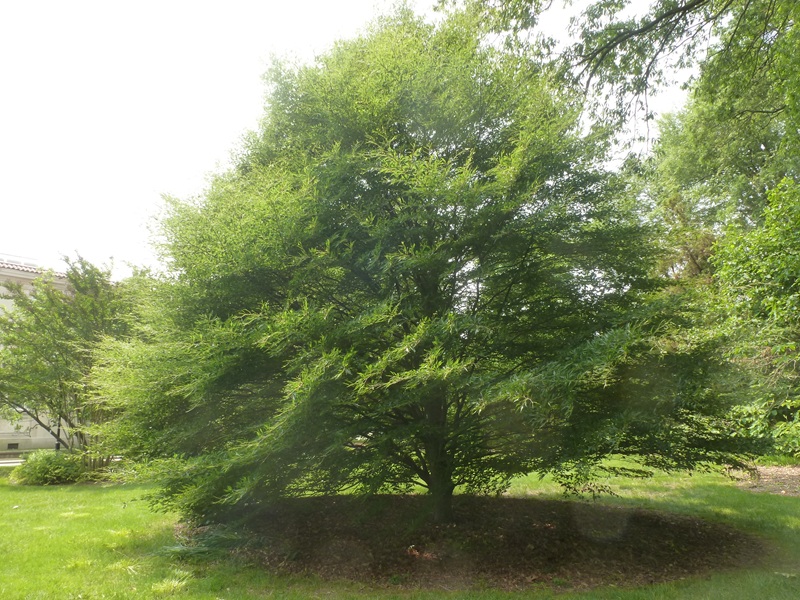
A century later, it is a beautiful and peaceful place, where visitors can stroll on woodchip paths that meander between a variety of trees, ranging from California redwoods to pines from China, and visit a “formal garden” that looks as if it belongs in a British period drama. In late spring, the lilacs are past bloom, but the peonies and roses were magnificent. The native mountain laurel was also in bloom, reaching the size of a tree. The vast majority of trees and plants had name tags. I enjoyed what I saw without trying to memorize the plants’ names and countries of origin. We took hundreds of photos. Here are some:


Another matter I wanted to write about is plain, whole milk yogurt that recently has become hard to find on the shelves of local stores. I did find several organic, non-GMO, and occasionally grass-fed types of yogurt with hard to believe prices, and even these were not always available. Gradually, the idea of home-made yogurt seemed more appealing. Yogurt is a two-ingredients product, I reasoned, and if the preparation process was complicated, people in Eastern Europe and the Middle East would not have made it for millennia. Previous experience with stuff bought and used once or twice, then left to clutter the kitchen for years, taught me not to buy new equipment before I make sure that my family will eat the new food. That left out yogurt machines, special ceramic bowls, thermometers and whatnot.

Next step was to search the internet for an easy recipe. A video clip How to Make Homemade Yogurt – No Machine Required showed that this is doable and not time consuming. I decided to start with a small batch, so if it would turn out inedible, I could use the soured milk to make pancakes.

It worked!

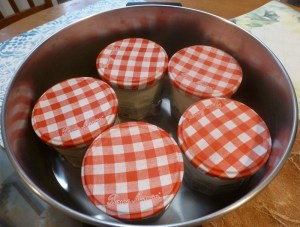
To make five jars of yogurt I use four and half jars of warm milk (regular whole milk from local dairies that verify that the milk does not contain antibiotics) and half a jar of starter (initially I used a store brand of organic whole milk plain yogurt and later the yogurt I made).

Preparation method: It is common to scald the milk, then wait for it to cool, and only then mix in the starter. The very serious seriouseats.com provides a scientific explanation why scalding the milk for several minutes yields a better yogurt. I tried this way and also to warm it just until I could hold a finger inside the milk, and did not notice any difference in taste or texture. One time, I absentmindedly mixed the starter into cold milk. Although I was skeptical that this batch could turn into yogurt, I poured the mix into jars, closed their lids and let them reach a comfortable temperature in a bath of warm water (again the finger test, i.e. holding it in the water for a few seconds). The culture did not care that something was amiss and at the end of the day (about 10-12 hours later), each jar contained yogurt!

My conclusion is that what matters most to make a mild, creamy yogurt is a) to use milk that does not contain things that would inhibit the culture and b) to give the milk and starter mixture enough time to mature in a warm environment.

yogurt in jars yogurt on a spoon
Posted in Desserts | Tagged , , , , , , , , , | 3 Comments

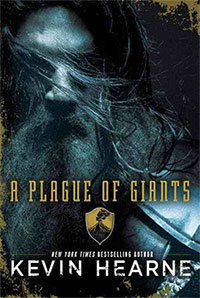
A Plague of Giants- high fantasy and an unexpected treat

“It is my life’s work to tell stories,” the bard continued, his smile gone now and replaced with an earnest tone. “And no one else can tell you what I have seen. This great war of our time has indeed been terrible, and I am still struck with its horrors, waking up in the night sweating and—well, I am sure I don’t have to tell you.”
From A Plague of Giants, a novel by Kevin Hearne.

When a book opens with a bard addressing refugees gathered at a place called Survival Field, I can either assume that the book is rife with death and gore and return it unread to the library, or assume that in this horrible situation the bard has something comforting to say to people already devastated by loss of their families and homes. Curious about the direction A Plague of Giants would take, I decided to give it a try. A Plague of Giants is a high-fantasy about 600 pages long, with eleven main characters. In my mind, long sagas with bards and mythical elements belong to ancient Greece and medieval Europe, whereas modern fiction is usually shorter and with fewer protagonists.* In novels I’ve read, main characters, even if they are scattered in different places and belong to different cultures, ARE UNITED by a main goal or event.

The beginning was not promising. I struggled to remember who is who and where different places are (there is a Dramatis Personae and a map, but flipping pages to check this or that was not conducive for immersing in the story). Even worse, the skeleton-like Bone Giants, whose deadly invasion on the eastern shores of the continent started the war, were a faceless, merciless evil without a glimmer of humanity. I did not want to know more about them. I continued to read because Hearne’s storytelling is engaging, the world-building is rich without being overly descriptive, and the magic is nuanced and intriguing. As the bard’s tale progressed, the Bone Giants’ thread turned out to be one of three. The other threads drew me to continue reading the story.

The Hathrim are fire-wielding giants (unrelated to Bone Giants) who settled without permission on a piece of land on the west coast of the continent. Strictly speaking, they’re trespassers, yet they are actual people with names, families, and human emotions. Most importantly, they did not sail to another country with the purpose to kill and conquer. They fled a volcanic eruption that made their island uninhabitable. Their ferocious and cunning Hearthfire (I think that’s their word for chieftain) made the most of the bad situation, and led the surviving Hathrim to a new place. Through a combination of physical strength, magic and deceit they occupied an uninhabited stretch of land and began to make it their home. Naturally, the local peoples took notice. Some wanted the newcomers to leave out of sheer nastiness. Others, mainly the plant-magic users of Forn, perceived a large settlement of giants armed with the destructive power of fire as a threat they could not accept.

The third thread is a tale of coming of age that seemed totally unrelated to any giants. In a country believed to be devoid of magic, a teenager decided to go against his family’s tradition and do everything differently. There was nothing world-shattering about the lad’s choice to inform his domineering father about his decision at the worst possible timing. However, the ramifications of a commonplace confrontation were unpredictable when untapped magic was involved.

Gradually, the disconnected tidbits about the war, various forms of magic and personal growth came together, and I could not put the book down. I enjoyed how the threads in A Plague of Giants were interwoven, how events followed “naturally” from previous ones, how magic was not an inborn trait of a few “chosen ones”. In this world, magic is a potential individuals choose to seek at a risk of their life. My only complaint is that this book ends abruptly on day nineteen of the bard’s tale, with one liner, “Continued in volume two, A Blight of Blackwings.”


* Obviously, I do not read much high fantasy, but I plowed through Lord of the Rings.

Posted in fantasy, fiction, literature | Tagged , | Leave a comment

The Death of the Artist – why artists deserve to get paid, amateurs suck, and the Big Tech kills Art

… when the sons of song descend to trade,
Their bays are sear, their former laurels fade.
Let such forego the poet’s sacred name,
Who rack their brains for lucre, not for fame:
Still for stern Mammon may they toil in vain!
And sadly gaze on gold they cannot gain!
Such be their meed, such still the just reward
Of prostituted muse and hireling bard!

From English Bards and Scotch Reviewers: A Satire by Lord Byron

Unlike the young Lord Byron (the satire was published when Byron was 21, recently graduated from Cambridge and about to embark on a Grand Tour), Deresiewicz, the author of The Death of the Artist argues that artists should be paid for their art. As far as I understand, the thrust of his reasoning goes like this:

  • Artists should be paid, because art is work and it deserves remuneration, like any other work.
  • Artists should be paid, because art is hard and it takes many years of focused dedication to reach an artistic level beyond amateurish. Although most artists are not in it to get rich, they still need food in their belly and a roof over their head.
  • Art has value, and therefore it ought to have financial value. While artists do not deserve compensation for doing what they love, “they do deserve to get paid for doing something you love, something other people love. That’s how markets work, by putting a price on other forms of value.”

But what happens when supply surpasses demand? The “starving artist” is not a new phenomenon. In the past, most artists did not eke a living off their art, but there was a considerable group of people who published books, exhibited in galleries or succeeded in other artistic pursuits while holding part-time (or full time) jobs. In the twenty-first century economy of “winner take all”, a tiny percent of artists grow very rich, and the rest are either forced to leave the field, risk starvation or turn into sellouts. The author blames Tech Giants for “the demonetization of content” by enabling the flow of cheap and often free art. This has devalued artistic work. Consequently, artists are either not compensated at all or barely compensated for the fruits of their talent and labor. Moreover, companies like Apple encouraged lay people to become “artists,” then Amazon and other Tech Giants let them flood the digital platforms with amateurish content. The glut of “art” obscured the much smaller offering of professional artists. To stay visible, they are coerced into working for exposure, to forgo pay for their work.

The Death of the Artist includes many interviews with artists and shows the human cost behind the statistics. The author clearly knows what he writes about, even though he calls himself a “snobbish old asshole”. Regardless of how he calls himself, I agree with him that people should be paid by those who consume their work and not be exploited by corporations. My qualm with the book is that it reads like an expanded essay on the evil tech companies and their useful idiots, the hobbyists, rather than a concise study of the field.

For example, The Death of the Artist claims that the traditional “culture industry” – publishers, music labels, art galleries, movie studios and so on – has successfully supported artists until a large chunk of their revenue was snatched by Amazon and other Tech Giants. The current plight of the artists, the author argues, is caused by the multi-billion culture industry’s inability to afford to nurture artistic talent. Obviously, the artists cannot depend on the new bosses, whose revenue is driven by algorithms. Tech behemoths monetize clicks and do not care about artistic merit.

This dire picture makes me wonder whether artists were better off before the balance of power had shifted from the culture industry to tech corporations. The author explains that capitalism enabled the emergence of the concept of “fine arts” in the Romantic age (end of eighteenth and early nineteen century), but says nothing about earlier cost-reducing technological advancements that erased entire disciplines. Movies are a cornerstone of the bastion of culture. A century ago, cheap cinema tickets had killed vaudeville shows. It is worth remembering that new technology was not the only source of artists’ growing woes. Consolidation through mergers and acquisitions in the “culture industry” in the second half of the twentieth century diminished the number of artistic venues even before Amazon entered the field. In publishing, the market was increasingly controlled by large corporations, until only six big publishers were left. The corporate practice to limit supply to below-demand, hurt the chances of new writers to get published and led to smaller advances (the payments for a work already done, but not published yet) for mid-list writers (i.e. professional writers who achieved recognition and had considerable readership in their genre, but who were not best-sellers).

Last but not least, the book repeatedly points to the harm caused by deluded hobbyists whose drivel cheapens art and diminishes the income of professional artists. These wannabes may not appeal to the highly-educated, elitist critics, but I am skeptical that legions of aspiring writers endanger literary careers. Professional artists do not merely vie for attention in an ocean of crap created by amateurs. They compete with the best in their field, dead and alive, from all over the world. For example, a work of literary fiction by an American author contends for readers with the ephemeral bestsellers, as well as with novels by Toni Morrison, Agatha Christie, J.R.R. Tolkien and many other classics (all available to be read with a single click). Talent and credentials like an MFA are insufficient to carve a career in the fine arts. Like Byron who had introduced the jaded, moody Byronic hero to readers weary of the endless Napoleonic wars, a modern artist may have a better chance to succeed if they have something new and relevant to say, something that will show off their genius and be both fresh and timeless.

PS. If the author of The Death of the Artist wants to explore a really scary scenario, he can update the book after AI gains the abilities to perform better than 99% of the artists.


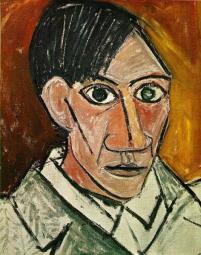
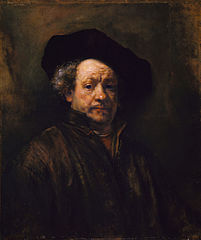
Self-portraits by Picasso and Rembrandt
Posted in fiction, literature, self-publishing | Tagged , , , , , | 3 Comments

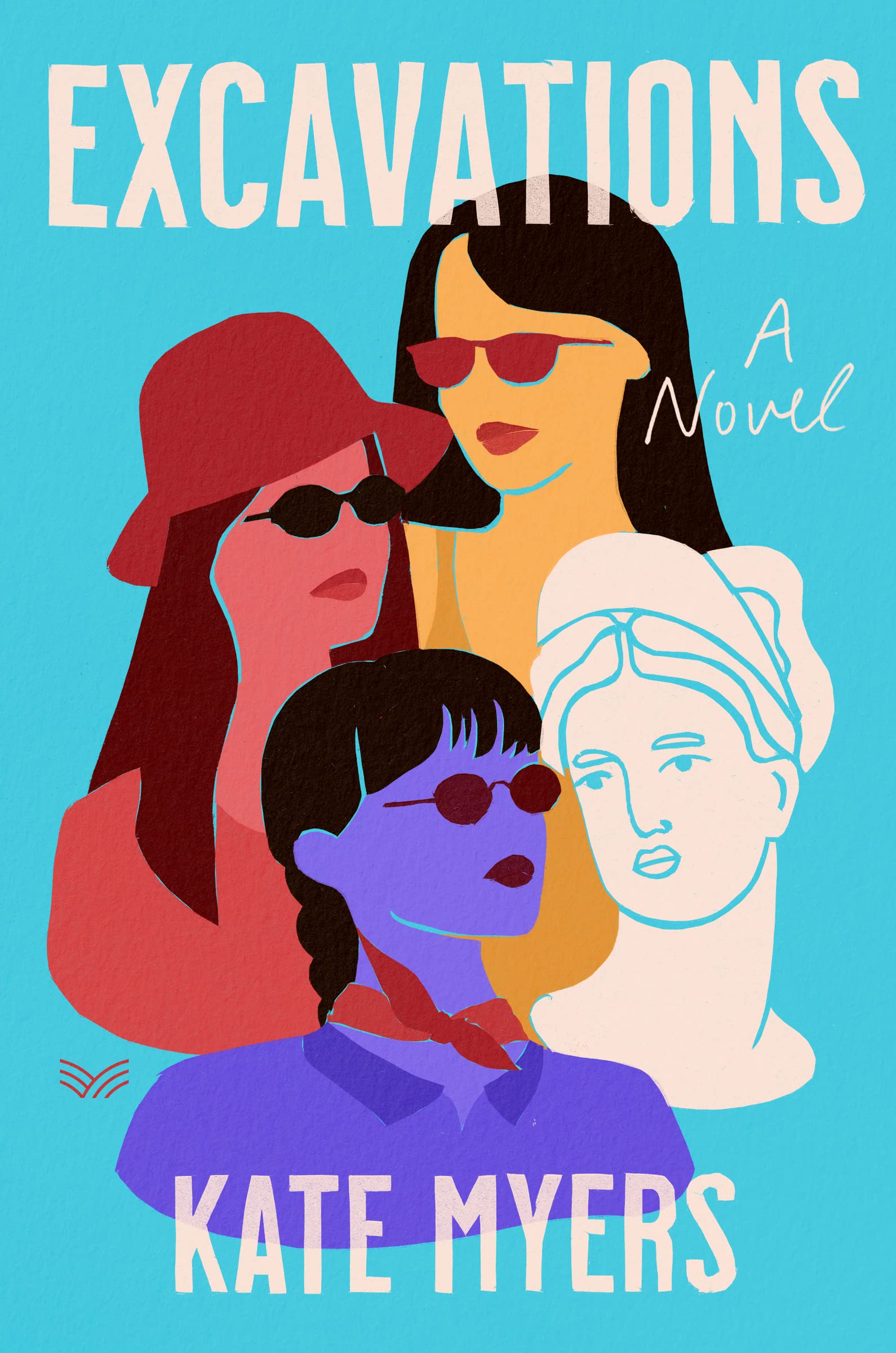
Excavations – Americans at a summer dig in Greece

“There was no evidence though. Archaeology alone was where the facts lived; this is why she respected it. No smoke, all fire. Speculations about that far back was just theoretical, and the only real truth – the only realness you could get your arms around to properly believe in – came from the ground.”
From Excavations, a novel by Kate Myers.

I borrowed Excavations from our library because an unimposing book about a group of archaeologists working in a remote mountainous area sounded like the right mix of chitchat, intrigue, natural obstacles and summer romances to read in the heat of early August. I was both right and wrong. Like the oft-mentioned baklava, Excavations is layered, with more substance than I expected and can be enjoyed all year round.

The novel starts in NYC, with the protagonist Z relaying how she was just dumped by her latest boyfriend, how her parents wanted her to settle down and how her life sucked both job-wise and men-wise. Now, in her late twenties, Z’s one great memory is a summer when she was an archaeology undergraduate working at an excavation with her first serious boyfriend. Miraculously, the same guy – but at the end of his graduate studies and apparently still single – emails Z about an opening for summer staff at an excavation site. Is it a wonder that Z immediately takes off to the Greek mountains?

It is hot in Greece during the summer, but a steamy romance has to wait. Charles, an American university professor who heads the excavation, is nearing retirement. Resolute to promote his lifework, he is pushing the staff to make discoveries that support his agenda. His methods to reach this goal include pitting archaeologists against each other, bullying the most vulnerable undergrads into snitching on others and clandestine activities that range between disgusting and unlawful. Charles’s right hand is Kara, a meticulous (both about her skincare and her lab work) and self-righteous grad-student who picks her allegiances – and her love-interests – in accordance to their suitability for her ambitions.

This academic alliance is confronted by Elise, a forty-something Brit who heads the field-work. Unlike Charles and Kara, Elise does not have degrees in archaeology. She is a no-nonsense, asocial woman. Undergrads fear her. Charles and Kara mistrust and despise her, yet the success of the excavation depends on Elise’s expertise to unearth noteworthy artifacts unscathed.

Once Z joins the dig, she finds that things are not as straightforward as she remembered from her student days. Her former boyfriend is engaged to Kara, but Kara professes that she does not intend to marry him. Elise blames Charles for “dickwashing history” by eradicating women’s achievements or attributing them to men. Determined to prove that The Heraean Games, in which girls competed in sports, had taken place at that remote site, she stealthily does her most important excavations at night. Eventually, rivalries and suspicions become as unbearable as the heat and Z must choose her side: will she join Elise’s dogged search for archaeological evidence, or will she take a leaf out of Kara’s book and fend for herself and for the guy she apparently still loves?

The further I read the novel, the more I liked Z. She is not a model career woman like Kara, nor a tough and headstrong heroine like Elise. Z tries and fails, then she tries again because she is quite optimistic but she is not Pollyanna. In her own words, “This always happened to her; multiple things were always wrong at once, and she always picked the wrong one to fix first.”

I also liked the humor woven throughout the book and the jibes about academic hierarchy. Undergrads from a prestigious university are called Ugs and are treated as nameless, cheep labor. The professor who leads the excavation is often depicted as over the top, petty chauvinist. Other men play minor roles, yet the novel is far from being a feminist manifesto. Z’s ex-boyfriend is very likable. Kara is quite heartless, even if “her heart was set on being a preservationist at one of the top houses, Christie’s or Sotheby’s, and yet neither had taken the bait on her impeccable resume.”

I recommend Excavations for being a fun and unconventional story. It took me to an interesting location and showed the sweat, the excitement and the temptations accompanying archaeological excavations.

Spartan running girl
Image from Wikipedia

Posted in academia, fiction, lab lit, literary fiction, literature | Tagged , , , | Leave a comment

Where does mass come from? *

Atoms are made from electrons and atomic nuclei. Since the nucleus accounts for more than 99.9% of the atom’s mass, we can focus on the nucleus, or on the protons and neutrons it is made of. Protons and neutrons are made from quarks (each particle contains three quarks) and gluons. Therefore, most of the mass of ordinary matter comes from quarks and gluons. But how can that be possible when gluons are massless and the up and down quarks which compose neutrons and protons are nearly massless?

The answer emerged 50 years ago (1973) and resulted in a Nobel Prize in Physics 2004 to Gross, Politzer and Wilczek “for the discovery of asymptotic freedom in the theory of the strong interaction.” In his Nobel prize lecture, Wilczek recounts that Einstein in his 1905 paper stated his most famous equation as m = E/c2. Another indication that Einstein considered the possibility that energy is the source of mass is that the title of the paper was a question, “Does the Inertia of a Body Depend Upon its Energy Content?

In the early 1970s, a new quantum field theory called QCD (Quantum Chromodynamics) was developed to describe the “strong force” between quarks and gluons (each up and down quark has a unit color charge. Color gluons interact with color charges or change one into another). In Wilczek’s own words:

“Modern QCD answers Einstein’s question with a resounding ‘Yes!’ Indeed, the mass of ordinary matter derives almost entirely from energy – the energy of massless gluons and nearly massless quarks, which are the ingredients from which protons, neutrons, and atomic nuclei are made.”

Although on its face this statement brings to mind creation of matter out of nothing, that is not the case.  Empty space is not really empty!!!   It is permeated with constantly changing quantum fields and their evanescent excitations, also called virtual particles. The color charge of a single quark or gluon is small, but even in “empty” space, a cloud of virtual particles builds up around the actual quark. The explanation of how the cloud enhances the strength of the color charge is very technical. Here it suffices to say that this process also requires a growing amount of energy. Since energy cannot be created from nothing, free quarks are not found in nature.

For a particle like a proton, energetically the most favorable scenario would be that the color charge of its three quarks would cancel out. For the color charges to cancel out completely, the quarks must exactly overlay each other. However, the uncertainty principle imposes limitations on how well the quarks could be localized: precise localization would require huge momentum, i.e. enormous investment of energy. Optimally, a particle will have the lowest possible energy.

“Thus, in seeking to minimize the energy, there are two conflicting considerations: to minimize the field energy, you want to cancel the sources accurately; but to minimize the wave-function localization energy, you want to keep the sources fuzzy. The stable configurations will be based on different ways of compromising between those two considerations. In each such configuration, there will be both field energy and localization energy. This gives rise to mass, according to m = E/c2, even if the gluons and quarks started out without any non-zero mass of their own. So the different stable compromises will be associated with particles that we can observe, with different masses…”

The citations are taken from Wilczek’s Nobel lecture. I recommend both to watch the video (it’s about half an hour) and to read the transcript. In 2009, Wilczek published a popular-science book, titled The Lightness of Being: Mass, Ether, and the Unification of Forces, which elaborates about the origin of mass. The book also addresses the feebleness of the gravitational force compared to the three other fundamental forces in nature (the strong, electromagnetic and the weak forces), and concludes with mathematically inspired speculations about a possible unification of the forces at ultrashort distances (i.e. huge energies inaccessible to any man-made machine). It also briefly discusses possible implications for understanding the cosmological puzzle of the dark matter. For me, the first part of the book that described in non-mathematical terms the “playground” where the creation of mass takes place was the most interesting (it is longer than the two other parts combined).

In the beginning of the chapter The Grid (Persistence of Ether), Wilczek states:

For natural philosophy, the most important lesson we learn with QCD is that what we perceive as empty space is in reality a powerful medium whose activity molds the world. Other developments in modern physics reinforce and enrich that lesson.

Another very interesting, and somewhat sobering part to read was the epilogue. Whereas the relation m = E/c2 explains how 95% of ordinary matter emerges from massless building blocks, modern physics cannot account for the mass of the electron. I conclude with Wilczek’s words:

“The mass of the electron, although it contributes much less than 1% of the total mass of normal matter, is indispensable. The value of that mass determines the size of atoms… And yet we have no good idea (yet) about why electrons weigh what they do.
…It’s a similar story for the masses of our friends the up and down quarks, u and d. They make a quantitatively small but qualitatively crucial contribution to the masses of protons and neutrons, and hence of normal matter. If their values were significantly different, life might become difficult or impossible. Yet we can’t explain why they have the value they do.”

————

The question does not refer to the “dark matter” found in galaxies nor to exotic particles that flicker into brief existence (for a very tiny fraction of a second) in high-energy experiments, but to ordinary matter made of atoms.

Posted in physics | Tagged , , , , , , , | 2 Comments

Flowers and food


This post was inspired by foxgloves blooming in our garden and a recipe for three-cheeses biscuits I promised to my sister. So here are the plants that are blooming right now, the recipe for the biscuits, and a recipe for cupcakes that uses some ricotta cheese left over from after I made the biscuits. The aroma while these cupcakes were baking was as delightful as their taste.

Three-cheeses biscuits

Ingredients:
2 1/2 cups all-purpose flour
2 teaspoons baking powder
pinch of salt
2 jumbo eggs
3 tablespoon extra virgin olive oil
1 cup whole milk ricotta cheese
1 cup sharp cheddar cheese, shredded
1 cup whole milk mozzarella, shredded

Makes about 15 biscuits

Preparation:

  1. Line a baking sheet with parchment paper. Preheat oven to 415ºF.
  2. In a small bowl mix flour, baking powder and salt.
  3. In a medium bowl whisk eggs, then add ricotta cheese and olive oil, mix well. Add the flour and mix.
  4. Add shredded cheddar and mozzarella, mix well (the dough might be a little sticky, but it is easy to work with).
  5. Form balls from dough and put them on the parchment paper about an inch apart. Bake for 20-25 minutes, until they are golden in color. Let the biscuits cool a bit before eating.

Chocolaty ricotta cupcakes

Ingredients:
1 1/3 cups all-purpose flour
2 teaspoons baking powder
1/2 teaspoon baking soda
pinch of salt
1/2 cup cocoa powder
1 stick (100 g) softened butter
1 cup granulated sugar
2 jumbo eggs
2 tablespoons brandy
1 cup whole milk ricotta cheese

Makes about 12 cupcakes

Preparation:

  1. Line 12 muffins cups with paper liners. Preheat the oven to 375ºF.
  2. Sift flour, baking powder, baking soda, salt and cocoa into a bowl.
  3. Beat the butter and sugar until fluffy, add eggs and brandy and mix again (I use a food processor).
  4. Add 1/3 of the flour and mix, then add ½ cup of ricotta cheese and mix. Repeat ending with the flour.
  5. Fill the muffin cups. Bake for 20-25 minutes until a toothpick inserted in the center comes out clean.

The cupcakes were eaten with great enthusiasm even though they were without frosting.

Enjoy!

Mountain Laurel in our garden

Blackberry blooming in our garden

Hybrid tea rose in our garden

Posted in cakes and desserts, Desserts, recepies | Tagged , , , , , | Leave a comment

Daring to Dream – fiction and reality

“I want to make a toast, please. To the women in my life. My mother, who’s shown that love makes a marriage bloom. My friend,” she said, turning to Ann, “who always, always listened. And my sisters, who gave me the best of families. I love you all so much.”
Eighteen-year-old Laura, just before her wedding ceremony, from Daring To Dream, by Nora Roberts

“Late last week, Nora learned from PEN America that a number of her books were banned from school libraries in Martin County, Florida.”
From Nora Roberts’ blog, Fall Into The Story, The state of the world of books

One of the banned books is Daring to Dream, a romantic tale about three young women, Laura, Kate and Margo, each having a childhood dream. Born with a silver spoon, Laura’s aspiration in life is to start a family while her husband works at her parents’ hotel business. Adopted Kate “could discuss, happily, interest rates and capital gains with Mr. T. for hours.” Skipping a grade in high-school, Kate is heading to Harvard University at seventeen. Margo is the daughter of the family’s housekeeper. After graduating from high-school, she refuses to depend on her mother’s employers charity and goes to L.A. to get a job. Daring to Dream – and the next two books in the trilogy, Holding the Dream and Finding the Dream – follow the three best friends as they try to realize their aspirations and find both personal and professional fulfillment.

I read these books years ago and I still keep paperbacks at home. They are comforting and inspiring tales about young women following their dreams despite obstacles, about the power of friendship and loyalty to help one when she is down on her luck. It is hard to imagine less objectionable books.

So why the heck were these feel-good tales banned as pornography?

I cannot imagine any modern American woman more old-fashioned than Laura, a homemaker and devoted mother, whose life revolves around charities and driving her daughters to recitals and ballet lessons and whatnot. Career-obsessed Kate is more threatening as she is financially and emotionally independent, yet I believe that the culprit is the beautiful and often headless Margo. Unlike Laura, who waited to have sex until the wedding night, Margo is more free spirited. As Margo’s modeling career took off in Europe, she had a sexual relationship (not depicted in the book) with a married man. Was this the reason the book was banned from high school libraries? In the novel, the affair ruined Margo’s career and forced her to do serious soul-searching. That led her to a change of career and to a monogamous relationship with a man she knew and trusted from childhood. Since it’s a Nora Roberts romance it is easily to guess how the story ends – a marriage and later also an adorable baby. In real life, a sexual relationship with a married man did not disqualify a woman from becoming a First Lady, nor, in a more recent example, a Queen of Great Britain.

As Lord Byron had said in Don Juan almost two centuries ago:

‘T is strange — but true; for truth is always strange;
Stranger than fiction; if it could be told,
How much would novels gain by the exchange!

A final note. Daring To Dream was published in 1996. In 2023, some of the characters and their choices may not resonate with readers used to different outlooks and conventions. Personally, I like the book and recommend it without reservations as an uplifting and uncomplicated romantic tale. Regardless of whether the story will appeal to teenage girls, there is no justification to deprive the ones who depend on school libraries from access to these books.
The girls have no voice, but parents can demand that their daughters receive a decent education, and that includes access to books that encourage girls to follow their dreams.

Nora Roberts' banned books
Nora Roberts’ banned books – image from Nora’s blog Fall into the story

Posted in fiction, literature | Tagged , , , , | Leave a comment

A bookstore, supply and demand, and reality check for readers and writers

“Seventy-five dollars?” said Imp. “Just to play music?”
“That’s twenty-five dollars registration fee, thirty-five dollars up front against fees, and fifteen dollars voluntary compulsory annual subscription to the Pension Fund,” said Mr. Clete, secretary of the Guild.
From
Soul Music by Terry Pratchett

The conversation between Imp, a harp player who has just arrived to the city of Ankh-Morpork, and Mr. Clete, who “was not, by the standard definition, a bad man; in the same way a plague-bearing rat is not, from a dispassionate point of view, a bad animal,” revolves about a Catch-22 situation: a musician must earn money to pay the Guild of Musician’s exorbitant fees, yet he cannot play music without paying the Guild first.

I borrowed Soul Music from our local library, after I recently borrowed Pratchett’s Hogfather and Guards! Guards! According to Wikipedia, Terry Pratchett wrote 41 Discworld novels. A quick search discovered that my local library system doesn’t have most of them. Buying a few Discworld books (not audio-books or e-books) seemed like a good idea. But which ones?

I prefer not to read other readers’ reviews before I read a book, because of spoilers. Usually, after I add a current best-seller to my list on Goodreads, it recommends the author’s other books. When I gave five-stars to Hogfather, Goodreads did not send recommendations. This kind of digital silence (typically given to self-published authors) should have clued me that Pratchett’s books are not a must-have anymore.

Once upon a time books were bought in bookstores. The mid-Atlantic town I live in does not have a bookstore, so when I was in New Brunswick (the home of Rutgers University with tens of thousands students), I went into a Barnes & Noble store. The ground floor was packed with merchandise likely to attract students and visitors to the university – hoodies and t-shirts with university-related logos, the latest best-sellers, snacks and similar items. Fiction and non-fiction books (except textbooks) were on the second floor. In libraries, the stacks rise high. In that store, one did not need to lift their eyes to see the highest shelf. Shelves were few, low and separated by very wide aisles. Whoever runs the bookstore seemed reluctant to stock it with books. Or maybe they did not bother to display more books due to scant demand for the many thousands of titles published every year. In the fiction section, the books were lined alphabetically. At the letter “P”, between Jodi Picoult and Marcel Proust, I expected to see books by Terry Pratchett. There were none, which seemed impossible.

We live in a time when a lot of what I’ve thought as impossible turned to be possible. Maybe it has become unreasonable to expect a large bookstore to keep a book by a highly popular and prolific author? It turned out that I was not altogether wrong. A few paperbacks of Pratchett were found in the Science-Fiction/Fantasy “section”. A possible explanation: after he was knighted for “services to literature”, Sir Terry commented that, “I suspect the ‘services to literature’ consisted of refraining from trying to write any.”

Next, I turned to the 800-pound gorilla also known as Amazon. As I wanted neither e-books nor audiobooks, I searched in “books” for “Terry Pratchett discworld.”


The first six results (after sponsored products by another author) were free Audible audiobooks. Numbers seven and eight were kindle books. “Incidentally” both Audible and Kindle belong to Amazon.

The next four recommendations were Audible audiobooks again. Next came three sponsored books by other authors. Fed up with the shenanigans of the search, I left the Amazon page.

I can blame algorithms, inefficiency, or even a conspiracy against a liberal-minded author who laughed at the absurdity of greedy organizations. None of these, however, explains why a large bookstore leaves a considerable part of its space unused while it displays an abysmal selection of books (and I’m speaking about a very small group of hugely popular writers, others are completely ignored). I can make a guess on why a leading e-commerce giant pushes products of its companies, not out of a mere disregard, but as a manipulation of supply and demand.

From a certain point of view (for example, Mr. Clete’s), this is not a big deal. On the other hand, ignoring the problem, we let a trove of excellent books that are not the current runaway bestsellers to slip from our minds and fade into obscurity. This is not just a matter of current tastes and fashion. Our society relies on maintaining a balance between supply and demand. When the causality between supply and demand is disrupted (either purposely or by corporate carelessness), writers and readers should do a reality check.

I get more book recommendations in one week than I can read in a year, but the vast majority of the books I enjoyed didn’t come from AI analysis of previous preferences. They were discovered in conversations, reading reviews, or in occasional advertisements. (Famous writers who publish regularly or writers who can afford the prohibitive cost of advertising have an advantage in putting their work before readers’ eyes. Most of the writers don’t have the budget to move the needle, neither on Amazon nor in a physical store.) Libraries offer more than the latest best-sellers. It is my favorite place to try writers who are new to me and genres I usually don’t read. Sometimes, especially in non-fiction, our library doesn’t offer what I want. I usually turn to Amazon when I want to buy a book online, but there are other options, so at least for now, readers do not completely depend on Amazon. Nevertheless most readers, myself included, check out what is readily available. We don’t know what great books we miss.
They are right there, somewhere, along with great music and art, not necessary hidden but certainly obscured. I have no solutions and instead of casting blame, I conclude with citing Terry Pratchett again:

“And although the Guild had a president and council, it also had Mr. Clete, who took the minutes and made sure things ran smoothly and smiled very quietly to himself. It was a strange but reliable fact that whenever men throw off the yoke of tyrants and set out to rule themselves there emerges, like a mushroom after rain, Mr. Clete.
Hat. Hat. Hat. Mr. Clete laughed at things in inverse proportion to the actual humor of the situation.
“But that’s nonsense!”
“Welcome to the wonderful world of the Guild economy,” said Mr. Clete. “Hat. Hat. Hat.”

Posted in fiction, literature, self-publishing, writing | Tagged , , , , | Leave a comment