“In the popular imagination, Jane Austen spent nearly all of her life sitting in a parsonage, working on her embroidery, gossiping about the neighbours and writing novels confined to ‘three or four families in a country village’.”
From The Real Jane Austen, by Paula Byrne
A popular imagination is an interesting source – for who can deny that there are millions of people that have heard about Jane Austen, but never read her books, nor watched the movies based on them. If they know that writers usually read a lot, they might expect the lady to be well-read. And if they happen to hear that Austen described many balls and naval officers, the streets of Bath and grand houses like Pemberley, they can expect her to also travel a bit. But what if someone is suddenly interested to find out the “real” Jane Austen? After reading the Wikidepia article, s/he might want to learn more about Austen’s daily life and the sources she drew her information from. Can The Real Jane Austen, by Paula Byrne, live up to the task?
My impression is that Ms. Byrne had focused on details rather than draw a cohesive image of the legendary Jane Austen. Her agenda, it seems, was composed of two goals:
One was to dispel the portrait of Jane Austen fostered by her family, a portrait of a woman who lived a life of “of usefulness, literature, and religion” in an enclosed, sequestered world. Since this is not the first Austen biography that I have read, I know that this task has been achieved previously.
Byrne’s second goal was way more ambitious. Throughout the book she tries to convince the reader that Austen was a free-spirited career woman. Or, in Ms. Byrne’s own words “… the consummate professional, the woman prepared to devote her life, and to sacrifice her prospects of marriage, to her art as a novelist.”
In my opinion, the evidence that Ms. Byrne has brought to argue for her image of Jane Austen is highly speculative. Some of it is based on recollections of family members who barely knew Austen. Even more troubling is the “evidence” drawn from a modern interpretation of Austen’s novels. An example of the latter is the biographer’s statement that Eliza (Jane Austen’s cousin and later also her sister-in-law) “was a muse for Jane Austen”. This speculative assertion, however, does not rely on anything Austen herself communicated about Eliza; it was deduced just from the fact that Austen dedicated her youthful story Love and Friendship to Eliza and maybe used details about Eliza to bring to life a secondary character like Mary Crawford. Yet, if Ms. Byrne is right and Eliza was indeed “Austen’s muse”, why did Eliza’s influence not extend to the more prominent characters like Elizabeth Bennet and Anne Elliot?
 Another assertion that I found puzzling is that Austen had a very modern openness about sex. The biographer wrote that “Jane Austen was certainly not prudish about sex”, but how does she know that? We can hypothesize whether Austen spoke freely about sex in her private correspondence, but both “yes” and “no” are just guesses. Maybe such letters existed, but none of them survived. In the absence of supporting evidence, either letters or recollections from those who knew Jane Austen, the biographer supports her conjecture using a very speculative interpretation of Austen novels:
“Jane Austen also wrote about woman’s sexual pleasure. In the character of Lydia Bennet she presents us with a lusty teenage girl who enjoys sex before marriage with Wickham with very little concern for the consequences…
The image of the torn dress as a symbol of sexual disgrace is also used in Pride and Prejudice. Lydia sends a request to her maid that she should ‘mend a great slit in my worked muslin gown’. We do not have to be Freudians to recognize a shocking image of her sexual transgression. Lydia’s “slit” can’t be mended, except by forced marriage, which is exactly what happens, though no one is fooled by the ‘patched-up business’.”
Okay, I’m not Freudian, nor do I belong to any other school of psychology. For me a passage about a careless teenager who wants her torn dress to be mended is not a proof that Austen wrote about sex. I’d like to see some solid evidence for that hypothesis, which is peddled as if it were a fact.
The last point I want to question is the assertion that Austen made a conscious choice to promote her writing career at the expense of matrimony. The biographer tells us that Austen “did not want her voice to be stifled by marriage. She was, I believe, happy to remain single.” Again, this claim is not grounded in Austen’s correspondence. Apparently, Austen “did not envy the women of her acquaintance who were married and exhausted by husband and children”. Let’s stop and think for a moment: is there a man or a woman who wants to be in the shoes of those exhausted women? It is quite plausible that Austen dreaded the reality of giving birth year after year, or that she feared the possibility of dying in childbirth. Do such natural feelings imply that a woman does not want to have a family? The biographer names men that Jane Austen rejected. But did Austen love (or at least liked enough to tie herself with) any of them? There is no indication that she refused a man she loved in order not to have children. There is no evidence to support the claim that she was a happy spinster, who did not regret Tom Lefroy or whoever had inspired the immortal Mr. Darcy.
I was not convinced by Byrne’s conclusion that Austen was happy not to have children. The biographer argues that Austen’s letters reveal her great love of children’s company, even those who were not related to her. We can only speculate whether she pined for her own kid or was one of those people who prefer to play with the children of others. I think that Austen wanted a family but only with the right man.
Byrne writes: “Love of children is often a guide to characters in the novels. Mr Knightly forgives Emma’s wrongdoing against Mr Martin when he sees her holding her baby niece in her arms…”. Captain Wentworth watches Anne Elliot when she kneels before injured Charles Musgrove, but when Charles’ stout two-years-old brother comes in and fastens himself upon Anne, Wentworth silently removes the troublesome toddler from her back.
Can a writer who did not care about having a man and children describe with such tenderness both Knightly’s and Wentworth’s response to a woman tending to a little child? For me, this is Austen’s cry for a real partner, a man whose understanding and emotions would be similar to those of Knightly and Wentworth.
Reading The Real Jane Austen, I found a plethora of details about Jane Austen and her family, their attitude toward slave trade, her love of shopping, what different nieces thought about the famous aunt and much more. The biographer depicted a witty and talented woman who “revised and improved and honed” her craft until she became a self-assured professional writer. She showed that Austen wanted both money and approbation, and that she was a dedicated follower of fashion. However, the portrayal of Jane Austen as a modern woman was as unconvincing as the claim that in her novels Austen wrote about sex.
To sum up, the biography tackled various facets of Jane Austen. Some of them were interesting to explore, but in all, they did not combine to form a portrait of the genius that Austen was.
Bonus:
Those interested in speculations about possible causes of Jane Austen’s premature death will be better served with the CNN article, “Jane Austen poisoned with arsenic? Not so fast, experts say”.
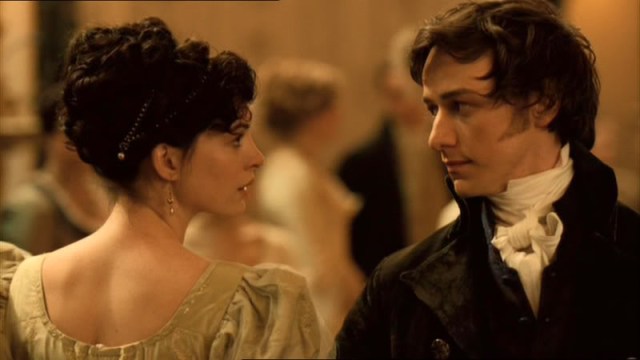
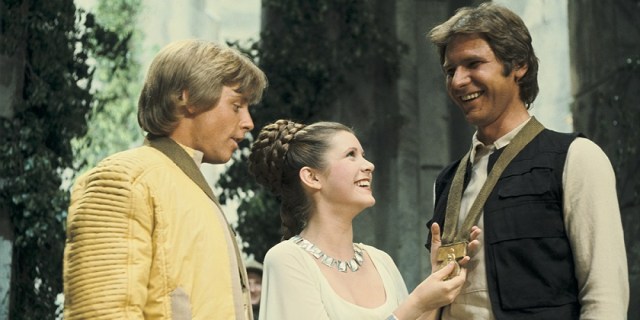
Those who prefer a more sentimental and visual approach (and don’t mind Jane Austen speaking with an American accent), might enjoy the movie Becoming Jane.
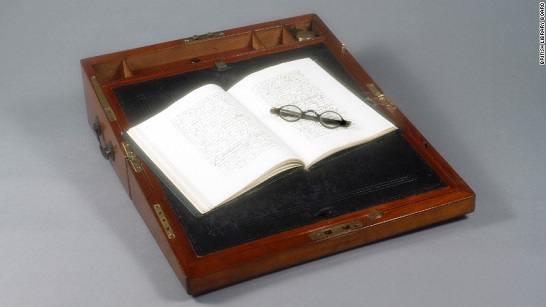
Image at the top – from the movie Becoming Jane
Jane Austen’s writing box – image from The British Library Board
















 “Concha and her friends flippantly called the new freedoms for women “liberation and lingerie” because of the exciting new undergarments that they now sometimes saw advertised in the newspapers. Having moved out of rural poverty herself when she married Pablo, she wanted to see Mercedes improve her life, too, and had been pleased at the prospect of her daughter growing up in a society full of opportunity. With women now in professions such as law and medicine and reaching positions of power and influence, Concha hoped that life for Mercedes would have more to it than polishing glasses and lining them up neatly along the bar. Though Mercedes seemed to think of nothing but dance, her mother regarded it as something of a childish pastime.”






 There is a lot of advice about writing and self-publishing. A recent tread from the
 If a book has all of the above in place, the book, once released, goes into the new release lists and there are hungry Amazon customers out there searching the new release lists every morning. That’s how a new release gets traction right out of the gate. Amazon algorithms see that a book is selling right out of the gate and takes notice. It perks up. Ahh, this book is selling itself. WE CAN SELL IT EVEN BETTER!