First anniversary – what I learned from a year of blogging

Sometime in August last year, I clicked on Publish for my very first post, a tantalizingly (or so I thought) worded question – “What is The Hungry Boson?” In retrospect, throwing a question about something that no one has heard about into the voids of the internet was totally pointless. But back then I had no experience. I gathered a lot of advice for newbie bloggers and used whatever seemed applicable, which included asking questions as a way to engage readers. “What readers?” I should have asked, before I followed yet another piece-of-wisdom from the net. I cannot recall what I had thought, or whose advise I followed when deciding upon the central topic of my blog. In fact, I visited other blogs, found some that I liked a lot, but scarcely any that tackled the assortment of issues I wanted to talk and read about. This lack of competition should have raised questions, but it did not deter me from following the advice to blog about topics one is passionate about. It made sense, and blogging gurus recommend it as means to draw like-minded readers, remain authentic, and have something to say that might be worthwhile. Bloggers are advised to post on a regular basis. It is often pointed out that writing on topics one cares about helps prevent burning out.
Armed with a plethora of collated advice and brimming with things I wanted to talk about, I started to blog. A year later, it’s time to address the advice and draw conclusions about what has worked for me.

Focusing on the topic. My blog is on “Physics and Fiction”. Skimming through the 44 posts I have so far, I find that they are mostly related to either subject. In physics-themed posts I addressed topics in cosmology, images from the Hubble Space Telescope, and history of physics. Since I completed a novel about a physicist pursuing her dreams, I’ve been on a constant search for similar stories. I found only a few contemporary novels with realistic physics. I blogged about these books at The Falling Sky – contemporary fiction with realistic physics, Science in Fiction, Shadow World – an unusual hero’s journey.
Physics and physicists play little role in fiction, yet female physicists/scientists are almost entirely overlooked (Professors in children’s books). My blog often mentions the existing asymmetry between male and female researchers in physical sciences. I even did a guest post for Tenure, She Wrote about Using fiction to explore realities for women in STEM.

Picturing my blog, I did not intend it to revolve about writing or publishing, even though these topics where on my mind when I started to contemplate self-publishing Initial Conditions. In the process, I discovered new blogs, some of which I still read regularly. The more I found out about self-publishing, the more I embraced the option. Since I wanted the blog to reflect my interests, information I gleaned and concerns I had had filtered into my posts. One of my most popular posts is Self-publishing a mainstream novel – Q&A with Catherine Ryan Howard.
I don’t always stay on these topics. Things that caught my eyes while looking for something else turned into posts. These are usually heavy on photos rather than words (Gargoyles in universities, National Libraries Day in the UK ) and get more likes than my carefully thought musing. Apparently readers of the blog prefer lighthearted, fun stuff over posts about CP violation, or my own favorite – Famous physicists – A to Z.

Other conclusions after 44 posts?

  1. Write whatever I feel compelled to say, read it, and occasionally dump the whole thing. Sometimes it helps just to pour out the words. Then, by the time I finish reading my musings, I’m ready to put the ugly/petty/annoying stuff out of my mind.
  2. Post regularly (usually at the end of the week) yet occasionally take a break or a vacation. This lack of diligence probably costs me visibility, but vacation is the time to change my routine, recharge, go to different places and meet people I don’t usually see. Breaks help to keep blogging something I enjoy and want to continue doing.
  3. Press on Publish if I like what I wrote. A blog post isn’t a novel, nor a scientific paper. It doesn’t require fussing, analyzing, or editing (at least not much). Publishing when one is still enthusiastic about the stuff brings a lot of satisfaction.

Posted in writing | Tagged , | Leave a comment

Waiting for a muse in a cafe…

The golden age of Prague café society was at the turn of the 19th and 20th centuries, when making an appearance at one of the elegant cafés was simply a social necessity. Surrounded by the aroma of good coffee and clouds of cigarette smoke, you would meet the leading writers, journalists, architects, artists and intellectuals of the day, who eagerly discussed politics or art or just sat quietly waiting for their muse to appear.
(From ‘Prague cafés’, at czechtourism.com)

Cafe Kafka in Prague
Café Kafka in Prague (Photo from Flickr)

Continue reading

Posted in fiction, literature, photos | Tagged , , , , , , | Leave a comment

The Perfect Theory – Physicists’ Battles for Muggles

After the ceremony, as the audience and speakers milled around, ready to escape into the London evening, a Polish physicist named Ludwik Silberstein ambled over to Eddington. Silberstein had already written a book about Einstein’s more restricted “special theory of relativity” and had followed Eddington’s presentation with interest. Now he pronounced, “Professor Eddington, you must be one of the three persons in the world who understand general relativity.” When Eddington was slow to respond, he added, “Don’t be modest, Eddington.” Eddington looked at him firmly and said, “On the contrary, I am trying to think who the third person is.”
From Prologue to The Perfect Theory, by Pedro G. Ferreira

Welcome to the secret world of physicists – the acid-tongued trailblazers who tower above their peers, the heads of powerful scientific dynasties, the disillusioned legends who are shunned by the younger generation. This is a world where a formidable mind keeps creating while confined to a wheelchair, a world than spans a handful of universities and virtually excludes women. You can meet them all in The Perfect Theory, A Century of Geniuses and the Battle over General Relativity.

Continue reading

Posted in academia, Big Bang, cosmology, physics | Tagged , , , | 4 Comments

Forty-two

“Tell us!”
“All right,” said Deep Thought. “The Answer to the Great Question…”
“Yes..!”
“Of Life, the Universe and Everything…” said Deep Thought.
“Yes…!”
“Is…” said Deep Thought, and paused.
“Yes…!”
“Is…”
“Yes…!!!…?”
“Forty-two,” said Deep Thought, with infinite majesty and calm.
      From The Hitchhicker’s Guide to the Galaxy by Douglas Adams

Not coincidentally, this is my forty-second post. So far, I’ve blogged about physics, women in science, self-publishing, and books I’ve enjoyed. For the forty-second post, I would have loved to come with an answer to one of the mysteries of the Universe, or at least to shed some light on how to succeed as an author. Right now I’m still looking for answers. If I ever crack either of the mysteries, I promise to share the answer right here on this blog!
Meanwhile, to celebrate the 42nd post and the commencing summer vacation,
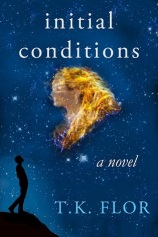
I have a GIVEAWAY of my book, Initial Conditions.

Never heard about it. What is it about? Initial Conditions is a contemporary story about love, career, ambition, and science. It is set in a physics department of a fictitious elite university. The protagonist, Danielle Meller, is an aspiring physicist, with a pretty good opinion about her abilities. When she realizes that determination and hard work are not all what it takes to succeed, she embarks on a quest to understand the enigmatic dark energy. On her path, there are conflicts within and outside academia, clashing and changing goals, a battle of wills, and… love.

Hmm. Can you be more specific about the genre?
Is it science-fiction? Romance? Both?

The story involves realistic physics. It’s not science-fiction.
Love and relationship play a big part in the novel, but it’s not a romance.
Initial Conditions is a ‘mainstream fiction’.

So, it’s not in a genre I’m familiar with. Who might like it?
I want the answer to be “Everyone,” but that may belong to the department of “wishful thinking”. Here are a few points to consider:
It is neither fast-paced nor action-oriented. There is no explicit sex or violence.
Some readers felt that there is “a bit too much physics” and “it covers a whole lot of theoretical physics making it sometimes more of a tutorial than a story”. Others readers responded differently:

“In all, this is not a book for everyone but still a very worthwhile read for anyone who, like me, identifies with the subject matter and academic life in general.”

“I’m a lawyer and therefore physics is as far from my field of interests as it possibly could be, yet somehow, this book made me want to understand it more. I found the segments with physics-related talk everything but boring (even if I didn’t understand most of it, naturally)…
I recommend this to anyone, really; especially those who are knowledge hungry :)”

(The quotes are excerpts from reviews on Amazon.com and Goodreads)

Unsure whether the story might appeal to you? Try the first four chapters.

Ready to give the entire book a try? Enter the GIVEAWAY.
You’ll find my email address in “Contact.” Email me and note which ebook format you prefer (mobi / epub / pdf) and I’ll send it using “reply”. I intend to send the ebooks as requests come, but it may take a few days.

When can one enter? Anytime until the 4th of July, 2015.

Catch? No catch. I’m not going to reuse your email address to spam you with requests to leave a review. On the other hand, after reading the book, you may want to leave a review (see a review as a thank you). This would be appreciated.

Anything else? Fiction with realistic physics is quite rare, and a female physicist is even less likely to be a protagonist. I ask you guys to help spread the word. If you know someone who might enjoy Initial Conditions, please tell him/her about the giveaway.


Posted in academia, cosmology, fiction, mainstream fiction, physics | Tagged , , , , , , , , | Leave a comment

Raisin cake and the expanding universe

“Put a raisin cake in the oven, and it’s very small. Then you let it go, and the distance between the raisins is like the distance between the galaxies – it gets larger and larger with time.”
Neta Bahacall, in “Hubble’s Guide to the Expanding Universe”.

“By observing distant galaxies with the help of telescopes, nearly 100 years ago scientists discovered that our universe is getting bigger and bigger. The distances between the galaxies are constantly increasing, like the spaces between raisins in a raisin cake swelling in the oven. If we extrapolate backwards in time, we realise that this expansion must have begun about 14 billion years ago – in a primordial explosion that British astrophysicist Fred Hoyle called the Big Bang.”
Olga Botner, The Nobel Prize in Physics 2011 – Presentation Speech.

As you can see, physicists love to describe the expanding universe as a raisin cake. Here are two recent variations of the theme: Continue reading

Posted in Big Bang, cosmology, fiction, literature, physics | Tagged , , , , | 5 Comments

Women in science: whom to ask for advice?

Through copse and spinney marched Bear; down open slopes of gorse and heather, over rocky beds of streams, up steep banks of sandstone into the heather again; and so at last, tired and hungry, to the Hundred Acre Wood. For it was in the Hundred Acre Wood that Owl lived.
“And if anyone knows anything about anything,” said Bear to himself, “it’s Owl who knows something about something,” he said, “or my name’s not Winnie-the-Pooh,” he said. “Which it is,” he added. “So there you are.”
Owl lived at The Chesnuts, an old-world residence of great charm, which was grander than anybody else’s, or seemed so to Bear, because it had both a knocker and a bell-pull.
From Winnie-the-Pooh by A. A. Milne

Why did Winnie-the-Pooh go through all this trouble? Because his friend Eeyore lost his tail, and he was “Moping about it”. Pooh is keen to help, but he doesn’t know what to do. So he seeks the advice of Owl, whom he considers as a great authority. Continue reading

Posted in academia | Tagged , , | Leave a comment

Old science-fiction and new research agree – paper is mightier than computer

“A paper computer?” said the general. He looked pained.
“No, sir,” said Shuman patiently. “Not a paper computer. Simply a sheet of paper. General, would you be so kind to suggest a number?”
“Seventeen,” said the general.
“And you, Congressman?”
“Twenty-three.”
“Good! Aub, multiply those numbers and please show the gentlemen your manner of doing it.”
“Yes, Programmer,” said Aub, ducking his head. He fished a small pad out of one shirt pocket and an artist’s hairline stylus out of the other. His forehead corrugated as he made painstaking marks on the paper.
General Weider interrupted him sharply. “Let’s see that.”
Aub passed his paper, and Weider said, “Well, it looks like the figure seventeen.”
Congressman Brant nodded and said, “So it does, but I suppose anyone can copy figures off a computer. I think I could make a passable seventeen myself, even without practice.”
“If you will let Aub continue, gentlemen,” said Shuman without heat.
Aub continued, his hand trembling a little. Finally he said in a low voice, “The answer is three hundred and ninety-one.”
Congressman Brant took out his computer a second time and flicked it, “By Godfrey, so it is. How did he guess?”
“No guess, Congressman,” said Shuman. “He did it on this sheet of paper.”
“Humbug,” said the general impatiently. “A computer is one thing and marks on paper are another.”
From The Feeling of Power, by Isaac Asimov

Asimov’s story, dated from 1957, takes place in a far-future, when a long-embattled Earth is engaged in a computer-directed war with Deneb. By then, writing numbers, let alone performing calculations on a paper, is a lost art. Continue reading

Posted in science fiction, writing | Tagged , , , , , | Leave a comment

Fictional choices

“It is our choices, Harry, that show what we truly are, far more than our abilities.”
From conversation between Dumbledore and Harry, at the last chapter of Harry Potter and the Chamber of Secrets, by J. K. Rowling

I recalled this statement a few days ago, while I was reading Hugh Howey’s Wool. In that novel, the protagonist, Juliette, is an extremely talented, strong-willed yet likable mechanic. Half a way through the story she makes an unprecedented choice, which results in an uprising, bloodshed, and more. As the story unfolds, Juliette’s responses and choices become almost super-human. I expected her to crumble under the pressure, but Juliette prevailed and even triumphed. Purged by water and fire, she morphs from an alpha-woman into someone unstoppable and indestructible. Then, at the very end of the book, one glimpses the “old” Juliette.

“Me? Mayor?” Juliette crossed her arms and sat back, painfully, against the chair. She laughed. “You’ve gotta be kidding. I wouldn’t know the first thing about –”

Continue reading

Posted in fiction, literature, mainstream fiction, science fiction, writing | Tagged , , | Leave a comment

CP Violation: what is it and when does it matter?

“Suppose the TV-news suddenly reported one evening that visitors from outer space were planning to land on Earth; that the space travellers have radioed a demand for immediate information about the composition of the Earth. Does it consist of Matter or Antimatter? The answer to this question is one of life and death. The two kinds of matter are known to annihilate each other atom by atom. The space travelers claim, furthermore, that the nature of their own kind of matter was determined before leaving. What they now want to know is, whether the same tests have been made on Earth. ”
from The Nobel Prize in Physics 1980 Award Ceremony Speech

In a nutshell, the answer is “Yes”. A difference in behavior between matter and antimatter has been observed in various experiments. However, it’s rare and very subtle. It cannot be observed in everyday life, and not even in physics labs.

Continue reading

Posted in cosmology, physics, science fiction | Tagged , , , | 2 Comments

Inge Lehmann: Discoverer of the Earth’s Inner Core

“You should know how many incompetent men I had to compete with —
in vain”
Inge Lehmann.

Quips aside, Inge Lehmann was a pioneering seismologist who discovered that the Earth has both an inner and an outer core. Continue reading

Posted in physics | Tagged , , , | 2 Comments