Who said it? Jude or Jane?

“Some people want to believe that the only difference between achievement and failure is luck. They like to sit on their couches and say that some sort of predetermined fate was why others made it and they didn’t. They never want to admit that hard work did it.”
From The Girl from Summer Hill, by Jude Deveraux.

“Her performance was pleasing, through by no means capital. After a song or two, and before she could reply to the entreaties of several that she would sing again, she was eagerly succeeded at the instrument by her sister Mary, who having, in consequence of being the plain one in the family, worked hard for knowledge and accomplishments, was always impatient for display.
Mary had neither genius nor taste… Elizabeth, easy and unaffected, had been listened to with much more pleasure, though not playing half so well;”
From Pride and Prejudice, by Jane Austen.

In the world of inherited wealth and privilege, working hard isn’t the best recommendation either for a young man or a woman. A “very fine young man, with family, fortune, everything in his favour,” does not need to work or even have a profession to be allowed to “think highly of himself.” The expectations from a gentlewoman are even stranger to our modern sensibilities. “A woman must have a thorough knowledge of music, singing, drawing, dancing, all the modern languages…and to all this she must yet add something more substantial, in the improvement of her mind by extensive reading.” And why would she make such an extensive effort? The only “career option” for a woman of certain social class was to attract a man who would marry and consequently support her. Sounds like a relic of a bygone era, not something relevant to the contemporary American society that glorifies hard work. Continue reading

Posted in fiction, literature | Tagged , , , , , , , , | Leave a comment

Can a nymph, an Amazon, a playwright, and a poet bring peace to Athens?

“Before the comedies were presented at the festival, it was customary for one of Athens’s great lyric poets to entertain the crowd with a few well-chosen pieces, to get them in the mood. As with everything connected with the festival, it was an honour to be selected.
“Luxos, before my actors walk onstage, the crowd will be entertained by one of Athens’s great poets. Does that include you?”
“Yes!”
“Only in your own mind.”
“But I could do it if I got the chance.”
“Come back in a few years when you’ve made your reputation, and I’ll consider it.”
“It’s not fair,” said Luxos.
“We’ve been at war for ten years. Nothing’s fair anymore.”
From The Goddess Of Buttercups And Daisies by Martin Millar

“It’s not fair” isn’t, by any means, a new statement, and even in 421 BC, it was unlikely to be original. So why would Aristophanes, also known as the Father of Comedy, waste his valuable time on an untried poor guy with no formal training, connections or credentials, when he desperately needs the best actors, props and an acclaimed poet to win the first prize with his controversial play Peace?

The role of an Artist at wartime is a deep question, and Martin Millar could have used the backdrop of Dionysia festival during the Peloponnesian War to explore the topic for a few hundred pages, adorning his premises with a plethora of historical information and elaborate literary contemplation. Luckily for me, the characters in the novel have much more to do than lament the hardships of artists in a materialistic society hardened by a decade-long war. Continue reading

Posted in fiction, humor, literature | Tagged , , , , , , , , | Leave a comment

Why does the Moon have phases?

“Moonspinners. They’re naiads – you know, water-nymphs. Sometimes, when you’re deep in countryside, you meet three girls, walking along the hill tracks in the dusk, spinning. They each have a spindle, and onto these they are spinning their wool, milk-white, like moonlight. In fact, it is the moonlight, the moon itself, which is why they don’t carry distaff. They’re not Fates, or anything terrible; they don’t affect the lives of men; all they have to do is to see that the world gets its hours of darkness, and they do this spinning the moon down out of the sky. Night after night, you can see the moon getting less and less, the ball of light waning, while it grows on the spindles of the maidens. Then, at length, the moon is gone, and the world has darkness, and rest, and the creatures of the hillsides are safe from the hunter and the tides are still…
Then, on the darkest night, the maidens take their spindles down to the sea, to wash their wool. And the wool slips from the spindles, into the water, and unravels in long ripples of light from the shore to the horizon, and there is the moon again, rising from the sea, just a thin curved thread, reappearing in the sky. Only when all the wool is washed, and wound again into a white ball in the sky, can the moonspinners start their work once more, to make the night safe for hunted things… ”
from The Moonspinners, by Mary Stewart

When Nicola, (a young Englishwoman on vocation on Crete) tells this legend to wounded Mark (an Englishman also vacationing there), she does so to sooth them both. Mark is feverish, but cannot seek a medical help in a nearby village without risking being found by the bad guys who shot him when he inadvertently witnessed a murder.
I’ve not encountered this legend before, and I couldn’t find whether it’s a part of Greek mythology, a folktale or a story invented by Mary Stewart. Anyway, I like both the “explanation” for the Moon phases and the peaceful, fanciful tone of the legend. For those who prefer an explanation without Naiades, here is a more scientific explanation (an excerpt from text by The University of Texas McDonald Observatory):

“The Moon has phases because it orbits Earth, which causes the portion we see illuminated to change. The Moon takes 27.3 days to orbit Earth, but the lunar phase cycle (from new Moon to new Moon) is 29.5 days. The Moon spends the extra 2.2 days “catching up” because Earth travels about 45 million miles around the Sun during the time the Moon completes one orbit around Earth.”


Image from NASA, via space.com
Image on top from www.mirror.co.uk

Posted in fiction, literature, physics | Tagged , , , , , , , , | Leave a comment

Love-story vs. Romance

“A lady’s imagination is very rapid; it jumps from admiration to love, and from love to matrimony in a moment.”
from Pride and Prejudice, by Jane Austen


Sometimes when my writing is stuck, my thoughts meander into such “philosophical” questions as “will I ever finish it?” or “what genre will it be?” (“it” refers to my would-be second novel). Since I cannot imagine a novel (even though I’ve read many novels) without a central love story, I occasionally wondered whether “it” might be a Romance. A ‘Romance’, I naively thought, is a love story with a happy end. To illustrate this assumption, The Princess Bride would be a romance, while Romeo and Juliet would not.

Recent threads in the Writers’ Cafe, this one, and this one (the latter includes explicit talk about sex), taught me that while every romance has in its core a love story, love plus happy ending aren’t sufficient to be called ‘Romance’. In the following there are some citations about what makes a romance a ‘Romance’:

“Princess Bride is not a Romance. It’s a fairytale, or action and adventure, or fantasy. Sure it has a strong romantic subplot but it’s not Romance with a capital R.
Romance (with the capital R) has certain expectations, no matter what sub-genre you write… women readers need to be able to relate to your heroine. She’s needs to have a flaw that other women struggle with.”
Tilly

“I think people get confused with “love story” and “romance”. Stories can have a love element, which relates to life. But unless the main focus is the relationship, it’s not a romance.”
she-la-ti-da

“The fantasy of romance is a man who will take care of you. So many women spend their lives taking care of other people. When they read, they don’t want to do the heavy lifting. It’s okay if the MCs take care of each other, but the hero must be attentive to the heroine’s needs. That includes her sexual needs.”
Crystal

“Romance is much more than a Happily Ever After. Romance is diverse, but it isn’t. It’s ALL, every kind of it, about a journey of two people toward love, toward connection in their life, through their own struggles and weaknesses. They have to be two people that readers can CARE about, and to do that, readers have to be able to identify with the heroine and fall in love with the hero IN THE BOOK. The hero and heroine have to fall in love deeply, passionately (by which I don’t mean sex) and exclusively, “forsaking all others.” There are many sub-genres but the differences are only on the surface.
Romance readers need to be able to identify with the heroine and fall in love with the hero.
The focus of the story is these two people’s journey toward love and a life together. It can also be their individual journeys, but the arc is a romance arc, even if there’s also a suspense arc or whatever else.
She’s had a hard time in some way or another. She meets him, and it’s a struggle to be with him, but they get there together, and they win. She wins. She overcomes.
If you don’t have those things, you can still be writing some other genre with a romance arc… But it probably won’t work as a romance, with a romance audience… Women are reading romance, from Pride and Prejudice on down, to be absorbed by the idea of a man who’s crazy about a woman, and a woman who wins in her life after some kind of struggle. Hopefully with the help and support of the guy. Romance is all about a woman and a man who are able to be vulnerable with each other, even if (especially if) with nobody else, who are able to be each others’ rock, each others’ safe place in a hard world.
(summarized from different posts of Rosalind James)

“Having romantic elements doesn’t make something a romance. You could totally remove the relationship from my books and they would still make complete sense in terms of plot. The romance between them is secondary and there for character purposes.
Most popular fiction has romantic relationship stuff in it. From Jack Reacher to Alex Cross to The Expanse to Game of Thrones, it’s got that stuff in it… relationships of a romantic/sexual nature are part of being human for most humans… people can be busy solving the mystery and killing the bad guy, but pretty much any book can be enhanced with at least the hint of relationships because nobody lives in a vacuum (unless of course that’s your story, kind of like The Martian which still had interpersonal interactions/friendships/etc despite the main char being stuck alone most of it).
To connect to readers, your main char will likely need to at least want to be in a relationship with someone even if it isn’t ever requited or to have someone want to be with them.”
(excerpts from Annie B)

“I write mostly mysteries and paranormal stuff, but I have found the romance angles are immensely popular in my books even though they’re not the main focus. People want to root for a couple and the romantic stuff helps because if someone else loves the character it’s easier for the reader to love the character.”
Amanda M. Lee

So, if I understood correctly, to be qualified as a Romance, a happily-ever love story has to have three additional elements:

  1. relatable (from readers’ point of view) heroine
  2. desirable (from readers’ point of view) hero
  3. the focus of the story is on the relationship between the two

One of the reasons for the diversity in Romance is that not every reader relates to the same type of heroine (e.g. shy and emphatic as opposed to feisty and a natural leader) or finds attractive the same kind of hero (brash “alpha male” vs. someone who is strong yet caring). However, if either of the main characters cares more about saving the world (or whatever) than their beloved, it’s definitely not a Romance, even if at the end of the story they live Happily Ever After without looking at anyone else…


Posted in fiction, literature, writing | Tagged , , , , , , , , | Leave a comment

Easy, breezy, accessible science

Guest post by mèþru:
I found this video about the misreporting of science in order to make it interesting for wide audiences. Comedian John Oliver discusses how reporters do not fact check the studies they report, make sweeping conclusions that barely resemble the content of the studies, and talk about science in a way that amounts to misinformation.

Posted in academia, humor | Tagged , , , , , | Leave a comment

Engineering Characters

“Miss Havisham had told me about Generics. They were created here in the Well to populate the books that were to be written. At the point of creation they were simply a human canvas without paint – blank like a coin, ready to be stamped with individualism. They had no history, no conflicts, no foibles – nothing that might make them either readable or interesting in any way. It was up to various institutions to teach them to be useful members of fiction . They were graded, too. A to D, one through ten. Any that were D-graded were like worker bees in crowds and busy street. Small speaking parts were C-grades; B-grades usually made up the bulk of featured but not leading characters. These parts usually – but not always – went to the A-grades, hand picked for their skills at character projection and multi-dimensionality. Huckleberry Finn, Tess and Anna Karenina were all A-grades, but then so were Mr Hyde, Hannibal Lecter and Professor Moriarty. I looked at the ungraded Generics again. Murderers or heroes? It was impossible to tell how they would turn out.”
from The Well of Lost Plots, by Jasper Fforde

So, how does one create enduring protagonists – is it a matter of craft? When a local library offered a workshop on “twists and turns of writing character,” I came to find out how to craft memorable, believable characters. Here is what I’ve learned:

  1. A character must want something. It can be a need, desire, ambition or goal. The stronger it is, the better it can propel the character to act. Since the world (and other characters) might have different goals, a character’s wants create conflict (the bread-and-butter of every story).
  2. A character must have some fundamental fear that he keeps in secret, which makes him vulnerable. The secret can be manifested as a trait, as a pivotal event from character’s past, or whatsoever as long as it sustains tension and raises the stakes.
  3. A complex character will have contradicting traits and flaws. Complexity of character leads to unpredictable reactions (especially at times of trial). Since reaction is usually followed by action, the chain of actions and reactions move the story forward. Unpredictable reactions give rise to suspense, through increasing the readers’ engagement (they keep wondering what will happen next).
  4. Genre demands. Physical appearance, age, and even some character traits arise from expectations specific to a genre. A world-weary, alcohol-abusing fat man in his fifties can be a great protagonist in a crime novel, but he is a very unlikely candidate to be the leading man in a contemporary romance.
  5. Character names matter. Since I don’t remember the examples from the workshop, here is one from Harry Potter and the Philosopher’s Stone: “Albus Dumbledore didn’t seem to realise that he had just arrived in a street where everything from his name to his boots was unwelcome.” Can anyone imagine a Hogwarts headmaster with a name like Jack or Steve?
  6. A hero of a story does not have to be larger-than-life. He can be an ordinary guy, but one who is able to rise to an occasion in unusual circumstances. Most people who have read O. Henry’s “A Retrieved Reformation” remember Jimmy Valentine with some tenderness, although they don’t particularly aspire to become a reformed criminal.
  7. Instead of using stereotypical “stock characters,” a writer can draw from real-life people she knows (family members, neighbors, co-workers…). Composite (and unrecognizable) characters can be assembled from bits and pieces of real people. The real challenge is to create characters that will become real to the writer, so real that she’ll feel her characters take initiative to roll their own story.
  8. There is no trusty recipe of how to create an “A-grade” character. Despite all the “craft” that can be learned, writing fiction is more Art than Science.

Posted in fiction, literature, writing | Tagged , , , , , , | Leave a comment

Double Rainbow

rainbow

Yesterday we saw a beautiful double rainbow. It hovered in the gray sky, two full arcs glowing with iridescent colors. The photos captured some of the splendor that we saw. Continue reading

Posted in photos | Tagged , , , | Leave a comment

Talking cosmology at a party

“…I barely know her, but if I were you, I would not mention cosmology.”
Jon’s advice was not surprising. Danielle did not mention what she was studying when the likely responses were astonished stares, ill-fitted jokes, and awkward silences before someone said that she must be very smart. Cosmology, experience had taught her and Jonathan, was not a profession one flaunts in a social gathering. It drew embarrassingly little interest, unless someone confused it with cosmetology.”
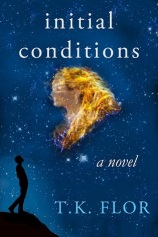
From Initial Conditions

A man I had briefly met once or twice before approached me at a party. He had heard that I published a book about physicists and wanted to know what qualifications I had to write about the subject. Apparently satisfied with my academic credentials, he shifted the conversation to cosmology. Going over all his remarks is way too long for the blog, but I think that the following three misconceptions are worth repeating and rebutting. Continue reading

Posted in academia, cosmology, physics | Tagged , , , , , , | 4 Comments

Sophomore novel – trying to recapture first love, or finding a second one?

“The problem with a second novel is that it takes almost no time to write compared with a first novel. If I write my first novel in a month at the age of 23 and my second novel takes me two years, which one have I written more quickly? The second, of course. The first took 23 years and contains all the experience, pain, stored-up artistry, anger, love, hope, comic invention and despair of a lifetime. The second is an act of professional writing. That is why it is so much more difficult.”
Stephen Fry, at the inaugural awarding of the Encore Prize, established to honor writers who successfully navigate the peculiar perils of the second novel. Quoted by themillions.com

It is often said that most people (about 80 percent of Americans) feel that they have a book in them. But did anyone check how many feel that they have MORE than a single book in them? Is writing more than one novel what separates laymen with literary aspirations from professionals? Continue reading

Posted in fiction, literature, self-publishing, writing | Tagged , , , , | Leave a comment

Tourism and fiction

“Japan’s smallest prefecture is aiming to attract more Thai tourists by sponsoring a series of romance novels set in the region.
The southern Kagawa Prefecture has teamed up with four Thai writers for the initiative, who have each penned love stories inspired by their travels around the area, the Kyodo news agency reports. The series has been named Kagawa, Let Love Lead, and was launched at Thailand’s National Book Fair in Bangkok.”
From BBC

Tourists following books are not a new phenomenon. People need to recharge, go away from their daily routine. They can travel to places, or “visit” them through literature, or both.

“The urge to get away, to travel, blends the phenomenon of escapism into the world of fiction. For literary tourists the primal source of escapism comes from the novels they read, inciting the desire to visit the place mentioned in the books. Thus, the ‘derived escapism’ transcends from literature into tourism. The illusion of the fictional world is perpetuated into the real locations used to attract avid readers and cinema buffs alike.”
(from Journeys Beyond Pages: The Use of Fiction in Tourism)

Continue reading

Posted in contemporary romance, fiction, humor, literature | Tagged , , , , , | Leave a comment