Maps of Physics and Fiction

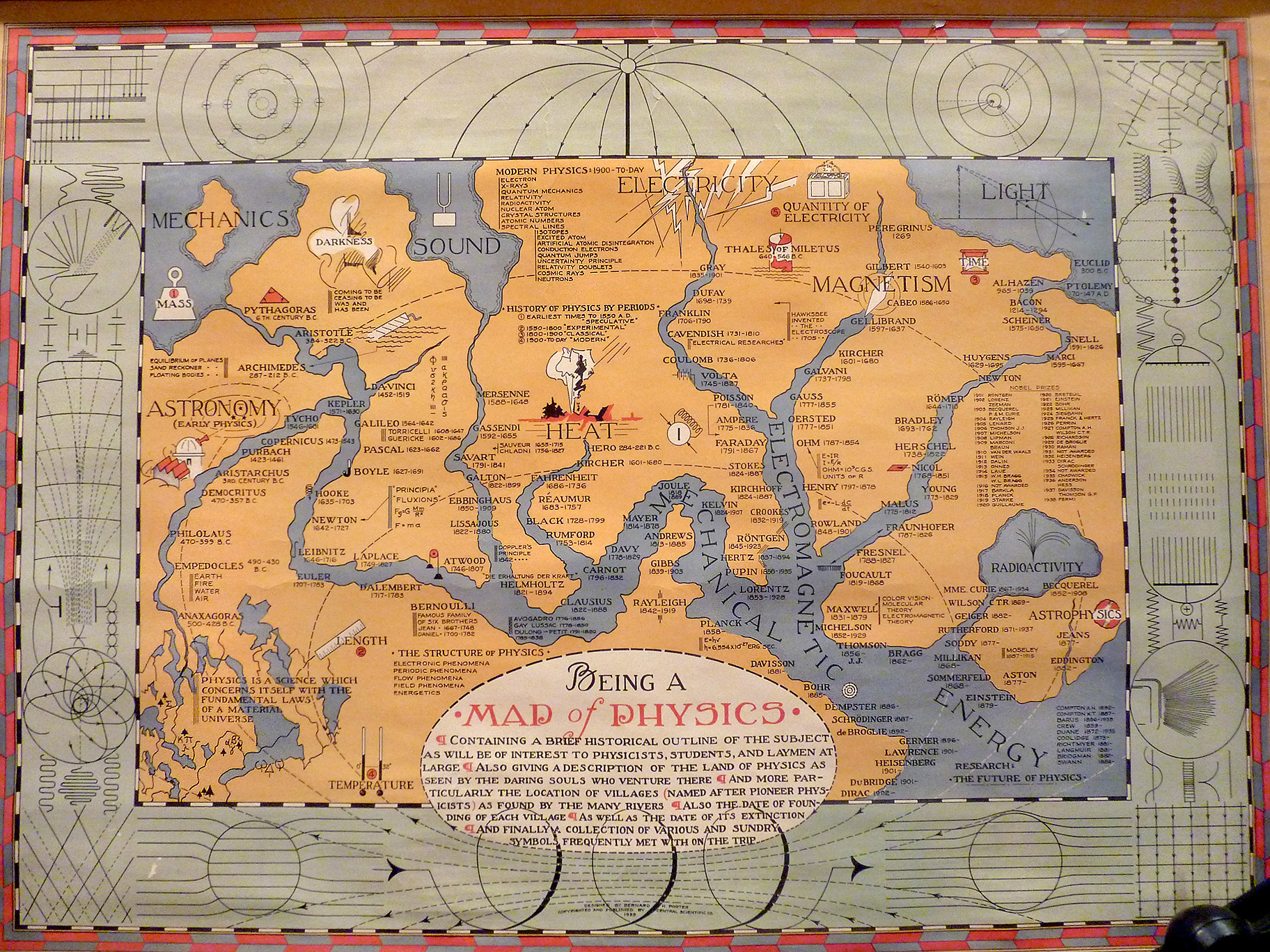
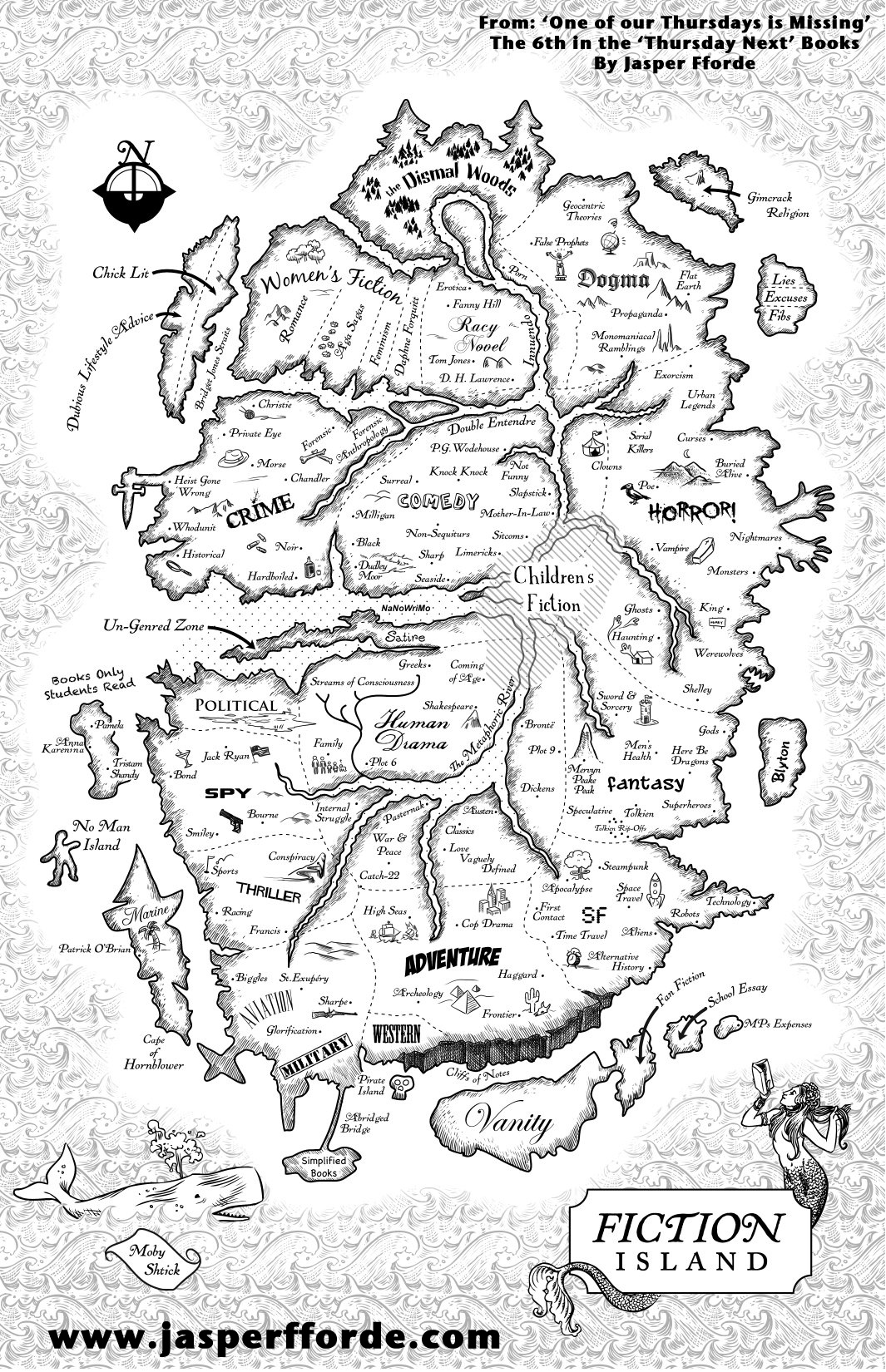
My two favorite subjects presented through maps:

Bernard H. Porter’s 1939 map depicting Physics as a continent, with rivers corresponding to its principal branches. From dabacon.org.


Fiction Island and a rough layout of the genres, from Jasper Fforde, 2011:


Posted in fiction, literature, physics | Tagged , , , , | 1 Comment

Albert Einstein’s birthday

“Imagine for a moment what the general opinion will be fifty years from now if the name Einstein does not appear on the list of Nobel laureates.”
M. Brillouin, in a letter to the Swedish Academy of Sciences, 1921.

Albert Einstein was born on March 14, 1879, in Ulm, Germany. He studied at the Institute of Technology in Zurich, graduated with an undistinguished record, tried and failed to get a university job. A recommendation from a father of a friend helped Einstein to get a position at the Swiss Patent Office in Bern. 1905 was Einstein’s magic year. In that year (while working at the patent office), Einstein produced six papers:

  • A paper on the light-quantum and the photoelectric effect.
  • A paper with a new determination of molecular dimensions.
  • Two papers on Brownian motion.
  • Two papers on special relativity. The second paper contained the relation: E=mc2

Late in 1906, Einstein became the founder of the quantum theory of the solid state, by giving the essentially correct explanation of the anomalous behavior of hard solids (such as diamonds) at low temperatures.
Between 1907 and 1911, Einstein focused his attention on the quantum theory. From 1911 to 1915 his main focus was formulating the general theory of relativity (which he published in November 1915).
(Summarized from Subtle is the Lord, the science and the life of Albert Einstein, by Abraham Pais).

American Institute of Physics has a brief Einstein’s Chronology. and also a more detailed account.

“ Einstein’s new general theory of relativity predicted a remarkable effect: when a ray of light passes near a massive body, the ray should be bent. For example, starlight passing near the sun should be slightly deflected by gravity. This deflection could be measured when the sun’s own light was blocked during an eclipse. Einstein predicted a specific amount of deflection, and the prediction spurred British astronomers to try to observe a total eclipse in May 1919 … The starlight had been deflected just as Einstein had predicted…

Announcement of the eclipse results caused a sensation, and not only among scientists. It brought home to the public a transformation of physics, by Einstein and others, that was overturning established views of time, space, matter, and energy. Einstein became the world’s symbol of the new physics. Some journalists took a perverse delight in exaggerating the incomprehensibility of his theory, claiming that only a genius could understand it. More serious thinkers — philosophers, artists, ordinary educated and curious people — took the trouble to study the new concepts. These people too chose Einstein as a symbol for thought at its highest. ”

Ready to check how much you know about Einstein?
Here are three statements. Only one is correct:
1. The celebrated relation E=mc2 is called Einstein’s equation.
2. Einstein received the Nobel prize for E=mc2.
3. Einstein called the “cosmological constant” he introduced, his largest blunder.


Posted in physics | Tagged , , | 1 Comment

Hubble Telescope celebrates 25 years of observations

“With the slow fascination of fear, he lifted himself on one arm and turned his eyes toward the blood-curdling blackness of the window.
Through it shone the Stars!
Not Earth’s feeble thirty-six hundred Stars visible to the eye; Lagash was in the center of a giant cluster. Thirty thousand mighty suns shone down in a soul-searing splendor that was more frighteningly cold in its awful indifference than the bitter wind that shivered across the cold, horribly bleak world …
“Light!” he screamed.
Aton, somewhere, was crying, whimpering horribly like a terribly frightened child. “Stars – all the Stars – we didn’t know at all. We didn’t know anything.”
Nightfall, Isaac Asimov

On our Earth, we are so familiar with the little twinkling objects dotting the sky, that we hardly pause to ponder on what lurks in the cold, dark space. Shielded behind the atmosphere, we look at the starry night, without feeling threatened. Occasionally, we may find the sight romantic or inspiring.
For astronomers, the haze of the atmosphere is disturbing rather than comforting. In the early 1900s, when the astronomer G. E. Hale looked for a place where observations would be unfettered by cloudy weather and poor seeing conditions, he chose Mt. Wilson’s 5700 foot peak, which overlooked the relatively unpopulated cities of Los Angeles and Pasadena (www.aip.org/history). In the 1920s, Edwin Hubble, for whom the Hubble Space Telescope is named, used the largest telescope of his day at the Mt. Wilson Observatory to discover galaxies beyond our own. (More about Edwin Hubble at: www.spacetelescope.org).

Another solution to evade the effects of the atmosphere is placing the telescope in an orbit around the Earth. The Hubble Space Telescope was launched in 1990 on the space shuttle Discovery. Since then, it whirls at 17,500 mph along a circular earth orbit of 340 miles altitude. The telescope can observe astronomical objects with an angular size of 0.05 arc seconds, which is like seeing a pair of fireflies in Tokyo from Maryland. Since its mission began, the Hubble telescope has made more than 1 million observations and has captured images going back to very distant past, at locations more than 13.4 billion light years from Earth. It is considered one of the most productive scientific instruments ever built. (Text summarized from NASA)

“In celebration of its 25th anniversary, Hubble has revisited the famous pillars, providing astronomers with a sharper and wider view. As a bonus, the pillars have been photographed in near-infrared light, as well as visible light. The infrared view transforms the pillars into eerie, wispy silhouettes seen against a background of myriad stars. That’s because the infrared light penetrates much of the gas and dust, except for the densest regions of the pillars. Newborn stars can be seen hidden away inside the pillars.”
Text from hubblesite.org

2014 Hubble WFC3/UVIS Image of M16
Source: Hubblesite.org. See a large photo here

More of the telescope’s images are featured in this pdf file.
Visit hubble25th.org to vote for the best Hubble image.


Posted in photos, physics | Tagged , , , , | 2 Comments

A smile from space

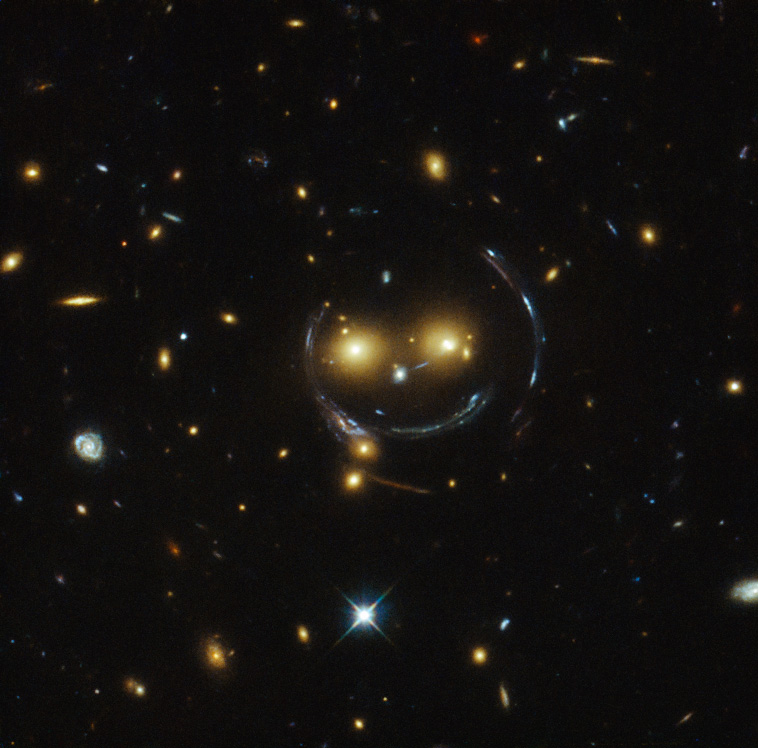
A smiling lens

“You can make out two orange eyes and a white button nose. In the case of this “happy face”, the two eyes are the galaxies SDSSCGB 8842.3 and SDSSCGB 8842.4.”
From the ESA website for the Hubble space telescope.

The smile, however, is an optical illusion. The lines are actually arcs created by a galaxy cluster. Such phenomena occur when a very massive object (and galaxy clusters are the most massive objects in the universe) is located between the distant source of light and the observer. The object deflects the “incoming” light from its original path, thus acting like an enormous gravitational lens.

The smiling image is a special case of gravitational lensing, known as Einstein ring.
For a non-mathematical, beautifully illustrated explanation, see “Einstein Rings: Nature’s Gravitational Lenses” by Leonidas Moustakas and Adam Bolton. Here is a short version:

When light coming from a distant source (such as a galaxy) passes through a strong gravitational field (created, for example, by another galaxy), the light is deflected from its course. To an observer, that light appears “bent”, as if it passed through a lens. If the source galaxy, the “lens” and the observer (in this case the Hubble Space Telescope) are aligned almost perfectly along the same line, the light rays from the faraway source will be bent all around the lens, forming a full Einstein ring.

I thought that Einstein’s rings are called so simply because gravitational lensing stems from Einstein’s theory of General Relativity (which he published in 1915). In Einstein’s biography, Subtle is the Lord, Abraham Pais points that it was Isaac Newton who suggested that

“Bodies act upon Light at a distance, and by action bend its Rays.”

In 1801, the astronomer von Soldner calculated from astronomical data the scattering of light-particles by the Sun according to Newtonian scattering theory. Einstein, who did not know of von Soldner’s work, became aware that gravitation caused the bending of light in 1907. At that time, Einstein thought only of terrestrial experiments as a means of observation, and therefore concluded that these would be too hard to perform. By 1911, Einstein realized that deflection of light by the Sun could be detectable. The value he calculated was quite close to the one von Soldner found.

To form a gravitational lens, a distribution of matter (such as a cluster of galaxies) has to be located between a distant source and an observer. It acts like a lens, because its strong gravitational field bends the light from the source as it travels towards the observer.
According to Tilman Sauer (in A brief history of gravitational lensing):

“Einstein jotted down the basic properties of such a gravitational lens in one of his notebooks, presumably on the occasion of a visit to Berlin in April 1912… The notebook contains rough sketches as well as the basic formulae needed to describe the lens effect… At the time, Einstein must have concluded that the lens effect would not actually be observable. In fact, the angle between the two images depends on the mass of the lens object as well as the distances between source, lens mass and observer; it is exceedingly improbable for two stars to be aligned so precisely as to produce a double image observable from Earth.”

Orest Chwolson published a paper about the effect in 1924, but the concept did not receive much attention until Einstein published in 1936 a brief note on the subject, in the journal Science. In the note, Einstein presented formulae for the optical properties of a gravitational lens, which he had derived some 24 years earlier. After Einstein published, the topic was followed by a number of articles by well-known scientists.

According to Wikipedia, the first Einstein ring was discovered in 1988, and the first complete Einstein ring was discovered in 1998.

.

Posted in photos, physics | Tagged , , , , , | 2 Comments

Guest post: Using fiction to explore realities for women in STEM

This was a guest post I wrote for Tenure, She Wrote.

Guest Blogger's avatarTenure, She Wrote

Today’s guest post is by blogger T.K. Flor, who has a PhD in physics.

Ten years ago, Lawrence H. Summers, then president of Harvard University, sparked a controversy by attributing some of the under-representation of female scientists at elite universities to “innate” differences between men and women. I remember the uproar in the media, the indignation of scientists, quoted in the press, and even some of the statements about universities’ commitment to encourage women to apply to tenure track positions. I can recollect some of the ensuing grumbling and bitching, but not as acutely as I remember a graduate student nastily complaining that women now had a better shot at getting an offer. I don’t remember any response from the members of faculty. I have no doubt that professors talked among themselves, but the topic was not raised in group meetings. On the surface everything was as usual – female…

View original post 936 more words

Posted in fiction, lab lit, literature, physics, writing | Tagged , , | 2 Comments

National Libraries Day in the UK

“Suppose we change the subject?” retorted the Cat, waving a paw at the surroundings. “What do you think of the library?”
“It’s pretty big,” I murmured, looking all around me.
“Two hundred miles in every direction,” said the cat offhandedly and beginning to purr. “Twenty-six floors above ground, twenty-six below.”
“You must have a copy of every book that’s been written,” I observed.
“Every book that will ever be written,” corrected the Cat, “and a few others besides.”
“How many?”
“Well, I’ve never counted them myself, but certainly more than twelve.”
Jasper Fforde, Lost in a Good Book, a Thursday Next novel.

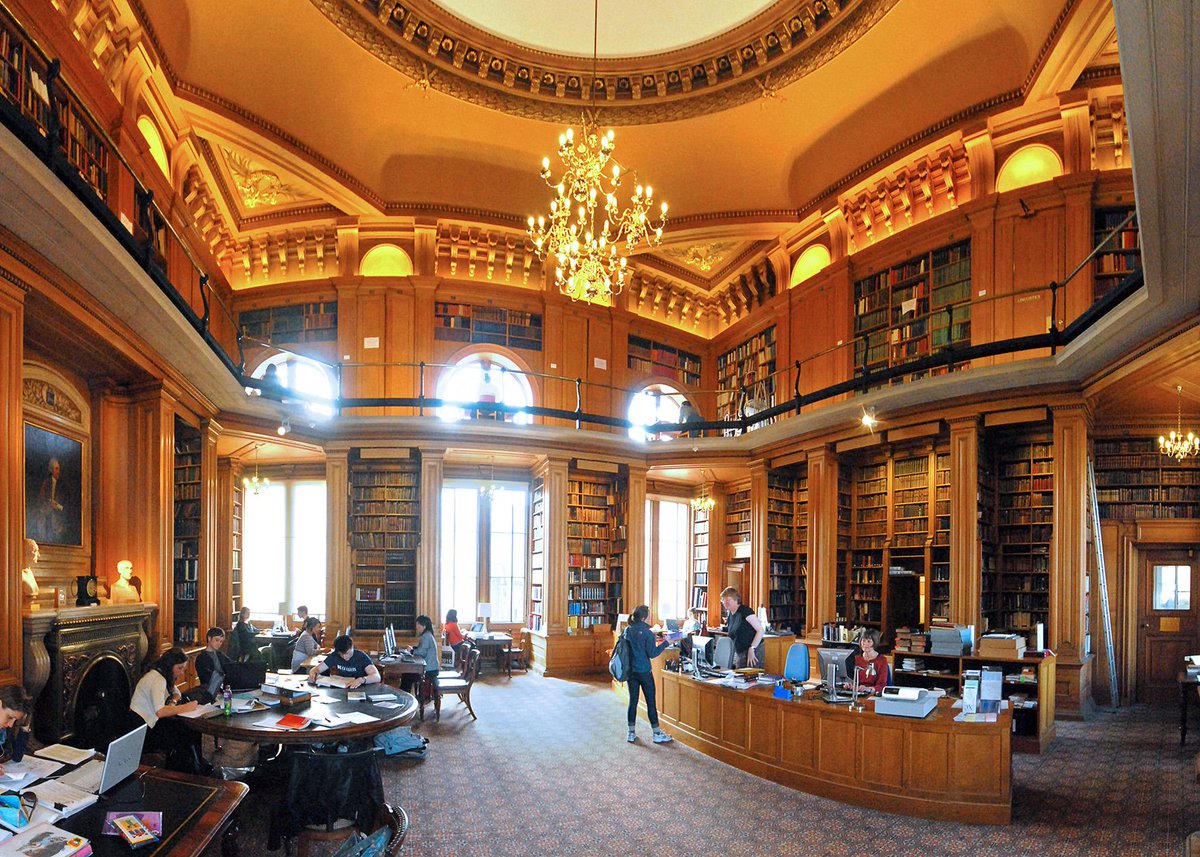
The Great Library of the Bookworld is too big to be captured in a picture. Maybe we can get a glimpse from looking at photos of libraries from around the world:

Baroque Library, PragueThe Baroque library hall inside Clementinum, Prague, Czech Republic
(Photo: Bruno Delzant, from Wikipedia)

Bibliothèque Interuniversitaire de la Sorbonne, Paris close
Bibliothèque Interuniversitaire de la Sorbonne, Paris
(Photo: Franck Bohbot, featured on BBC Culture)

OxfordUniversity
Oxford University Library
(Photo: Oxford University, featured on Twitter by@UniofOxford)

NYC Public Library
NYC Public Library Research Room
(Photo: Diliff, from Wikipedia)

Boston Public Library
(Photo: Franck Bohbot, featured on BBC Culture)

Reading Room at McKim Building
Reading Room in Boston Public Library, McKim Building (research collection)
(Photo: Brian Johnson, from Wikipedia)

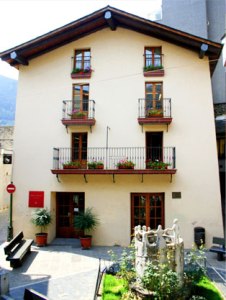
Perhaps the cutest (and most inviting) one is the National Library of Andorra

BNA


Posted in fiction, photos | Tagged , | 4 Comments

Emmy Noether: the mathematician who discovered the connection between Symmetry and Conservation Laws

“It is only slightly overstating the case to say that physics is the study of symmetry.”
P.W. Anderson (Nobel Prize in Physics 1977)
“More is Different“,
Science, 177, 4047 (1972).

By symmetry, Anderson writes, “we mean the existence of different viewpoints from which the system appears the same.”

According to The Feynman Lectures on Physics,  Hermann Weyl gave this definition of symmetry: a thing is symmetrical if one can subject it to a certain operation and it appears exactly the same after the operation. For instance, if we look at a silhouette of a vase that is left-and-right symmetrical, then turn it 180∘ around the vertical axis, it looks the same.

Water drops, snowflakes, and crystals are examples of natural objects with symmetries. But symmetries in nature are not limited to objects. They exist in the basic laws which govern the physical world.

What does it mean that a physical law is symmetrical?

For example, let’s look at symmetry under translation in space and in time.
Experiments are routinely done at different labs around the world. Symmetry under translation in space means that the outcome of an experiment is independent of where it is done as long as all the relevant conditions are the same.

Experiments are also conducted at different times. Symmetry under translation in time means that their results are the same (assuming that the measurements do not depend on seasons and such). In fact, “different times” can be billions of years apart.

For each of the rules of symmetry there is a corresponding conservation law:

  • Symmetry under translation in space means that momentum is conserved.
  • Symmetry under translation in time means that energy is conserved.

For other important examples see The Feynman Lectures on Physics.

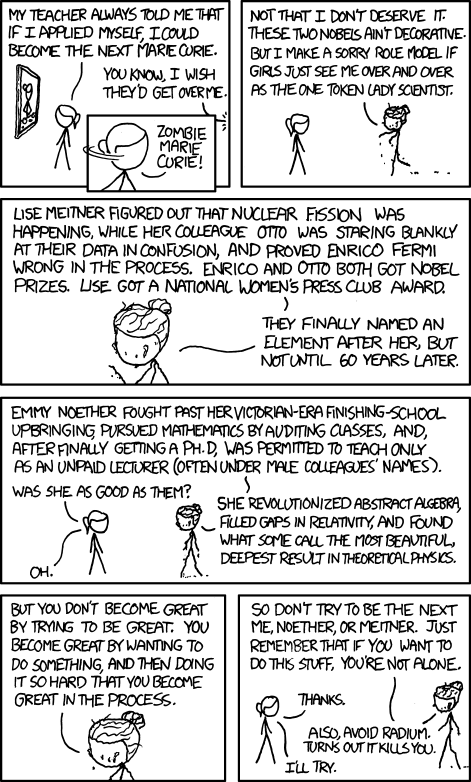
Quite surprisingly, the connection between symmetries in space and time and the fundamental conservation laws were not known during the nineteenth century, nor at the beginning of the twentieth. In a paper “E. Noether’s Discovery of the Deep Connection Between Symmetries and Conservation Laws”, Nina Byers follows the history of the discovery. Here is a shortened (and non-mathematical) version.

In 1915, Emmy Noether was invited to join the team of mathematicians assembled in Göttingen by David Hilbert. Shortly after she arrived, Albert Einstein gave six lectures in Göttingen, on the general theory of relativity. At that time the theory was not yet finished. However, the basic ideas were clear and his audience found them compelling. Although the general theory of relativity was completed in 1915, there remained unresolved problems. One of them was the principle of local energy conservation. In the general theory, energy is not conserved locally as it is in classical field theories – Newtonian gravity, electromagnetism, hydrodynamics, etc..

Hilbert asked Noether to look into the problem. Consequently, she began to study relativity theory. Out of that study came two papers which Hermann Weyl characterized as giving “the genuine and universal mathematical formulation of two of the most significant aspects of general relativity theory.”
Noether’s first theorem, which she proved in 1915, but did not publish until 1918, not only solved the problem for general relativity, but also determined the conserved quantities for every system of physical laws that possesses some continuous symmetry.

Upon receiving her work, Einstein wrote to Hilbert:

“Yesterday I received from Miss Noether a very interesting paper on invariants. I’m impressed that such things can be understood in such a general way. The old guard at Göttingen should take some lessons from Miss Noether! She seems to know her stuff.”

To get a more colorful account about Neother’s years at the University of Göttingen, I recommend to read “Women in physics in Fermi’s time”, also by Nina Byers.
To get the idea how is was, here is an xkcd cartoon



Posted in physics | Tagged , , , | 2 Comments

Book reviews for self-published fiction

“But there certainly are not so many men of large fortune in the world, as there are pretty women to deserve them.”
Jane Austen, Mansfield Park.

To paraphrase Jane Austen, there certainly are not so many book-reviewers in the world, as there are novels to deserve their attention. A lot has been written about getting reviews for self-published books. In this post I summarize what I’ve learned so far.

An overview:

IndieBookLauncher has a page, titled “Getting Your Indie Book Reviewed”, that discusses “Why Do Reviews Matter?”. It considers reputable companies, like Kirkus Indie Reviews and Blue Ink Review, that review self-published books for a fee. It also points to venues that don’t charge a fee. Under the umbrella of “Getting Reader Reviews on Book Vendor Sites”, it lists book giveaways on Goodreads (only for print books ) and on LibraryThing (both ebooks and paper books; however, not applicable for free ebooks), Shelfari’s free ebooks group, Amazon’s KDP Select Program and Kubo’s promotions. There are also links to blogs and discussion boards.

Reviews by reviewers

The Indie Reviewers List provides links to websites that review self-published books for free. The websites are listed alphabetically according to reviewer’s name. The list indicates which genres each website reviews and where the reviews are posted.

Reviews by readers

  • IndieBrag (Book Readers Appreciation Group) focuses on fiction. Self-published authors can suggest an ebook for consideration (this requires a non-refundable payment of $20.00). According to the cite, “On average, 50% of the books submitted to us fail to pass the initial screen and another 40% are subsequently rejected by our readers. Thus, only 10% of the books we consider are awarded our B.R.A.G. Medallion and are presented on our website.”

  • Goodreads Authors/Readers. This big group (almost 20,000 members) of readers and Goodreads authors is divided by genres. Authors can introduce their books, ask for reviews, announce giveaways. There are also threads to book review blogs and other resources.

  • An advice by Catherine Ryan Howard, the author of Self-Printed:
    “Find the book’s (that is similar to yours – TK) Goodreads page and contact the users who gave it 5* and are accepting messages. (You can send private messages to non-friends but they are limited to I think around 12 a day). Offer them a complimentary copy of your book to review.”
    (See more advice here).

Reviews by other indie-authors

  • GOOD REVIEWS is a Goodreads group where authors who are looking for reviews can post their books for review.

  • Review Group is a Goodreads group where authors get reviews from other author members, and in turn give non-reciprocal reviews to other authors in their reviewing group. In each round a member reads and reviews four allocated books. Reviewers cannot choose the books they get for review. There are three types of groups. General includes all genres of fiction, “from literary works, children’s books, and poetry to horror and erotica” and all non-fiction. Clean – with absolutely NO explicit sex, NO violence. And 18, where one will predominantly be reviewing books with explicit sex and/or violence.

  • The Reviews Initiative for Indie Books is a Goodreads group open to authors willing to read and review an Indie author’s book, and post their review on Amazon and Goodreads. In return, a different author agrees to read and review your book. You can choose whether to take the current offer for review, or wait for another book, but you don’t know who is going to review your book.


  • If you know of other review sites, blogs or groups, please share the information in the comments.


Posted in fiction, self-publishing | Tagged , , , , , | Leave a comment

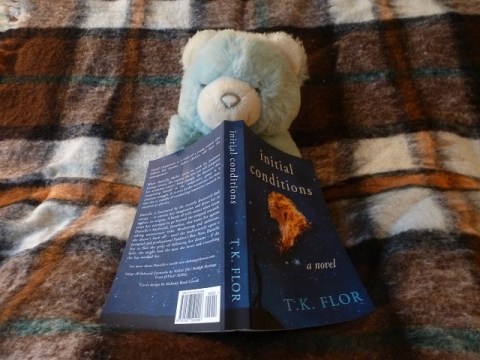
Initial Conditions paperback – first view

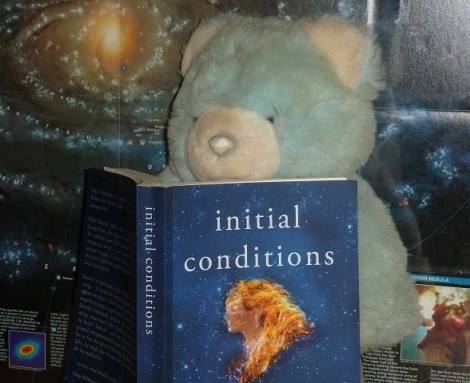
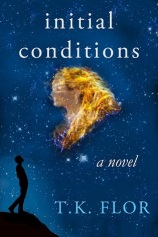
The proof copy of Initial Conditions paperback has finally arrived.

PKa
PKb
PKc
PKd


Posted in fiction, mainstream fiction, photos, self-publishing | Tagged | 1 Comment

Professors in children’s books

I was looking for information on how women scientists are portrayed in fiction when I found a blog post by Melissa Terras (professor at University College London) on how children’s books portray scientists and other academics.
Here is an excerpt:

What are academics in children’s books like?
The 108 academics found consist of 76 Professors, 21 Academic Doctors, 2 Students, 2 Lecturers, 1 Assistant Professor, 1 Child, 1 Astronomer, 1 Geographer, 1 Medical Doctor who undertakes research, 1 researcher, and 1 lab assistant. In general, the Academic Doctors tend to be crazy mad evil egotists (“It’s Dr Frankensteiner – the maddest mad scientist on mercury!”), whilst the Professors tend to be kindly, but baffled, obsessive egg-heads who dont quite function normally.

The academics are mostly (old, white) males. Out of the 108 found, only 9 are female: 90% of the identified academics are male, 8% are female, and 2% have no identifiable gender (there are therefore much fewer women in this cohort than in reality, where it is estimated that one third of senior research posts are occupied by women).  They are also nearly all caucasian: only two of those identified are people of colour: one Professor, and one child who is so smart he is called The Prof: both are male: this is scarily close to the recent statistic that only 0.4% of the UK professoriat are black. 43% of those found in this corpus are are elderly men, 33% are middle aged (comprising of 27% male and 6% female, there are no elderly female professors, as they are all middle age or younger). The women are so lacking that the denoument of one whodunnit/ solve the mystery/ choose your own adventure book for slightly older children is that the professor they have been talking about was actually a woman, and you didn’t see that coming, did you? Ha!

.chart.

The earliest published academic in a children’s book found was in 1922 (although its probable that the real craze for featuring baffled old men came after the success of Professor Branestawm, which was a major international bestseller, first published in 1933, and not out of print since). The first woman Professor found is the amazing Professor Puffendorf – billed as “the world’s greatest scientist” -,  published in 1992, 70 years after the first male professor appears in a children’s book. 70 years (although it is frustrating that the book really isn’t about her, but what her jealous, male lab assistant gets up to in her lab when she goes off to a conference. More Puffendorf next time, please). There is also a more recent phenomenon of using a Professor as a framing device to suggest some gravitas to a book’s subject, but the professor themselves does not appear in any way within the text, so its impossible to say if they are male or female.  Male Professors in children’s books have appeared much more frequently over the past ten years: women not so much.

Here is the link to the blog, titled Male, Mad and Muddleheaded: The portrayal of academics in children’s books is shockingly narrow.

I highly recommend to read the entire blog. I found the last section, titled “Why is this relevant?”, to be especially thought-provoking. You can see why, from this excerpt:

That said, the difference in gender, and how women and men are represented, and the underepresentation of those who are anything but white in children’s books about academia, is shocking, especially given that almost all scientific fields are still dominated by men, and women are frequently discriminated against and although 46% of all PhD graduates in the EU are female, only 1/3 of senior research posts are occupied by women. At a time when researchers are asking if available toys can influence later career choice, can the same be said about books? At a time when it is becoming the parents’ job to encourage girls into science and technology – and to educate all children about science and engineering careers – does the lack of anything but white, old men as academics in children’s books reinforce the impossibility of anyone other than those making a contribution? At a time when the leaky pipe of academia shows that women are leaving in droves at every level of the academic ladder, should we be worried that there are no female academics in children’s books above middle age?


Posted in fiction | Tagged , , , , , | 2 Comments