National Libraries Day in the UK

“Suppose we change the subject?” retorted the Cat, waving a paw at the surroundings. “What do you think of the library?”
“It’s pretty big,” I murmured, looking all around me.
“Two hundred miles in every direction,” said the cat offhandedly and beginning to purr. “Twenty-six floors above ground, twenty-six below.”
“You must have a copy of every book that’s been written,” I observed.
“Every book that will ever be written,” corrected the Cat, “and a few others besides.”
“How many?”
“Well, I’ve never counted them myself, but certainly more than twelve.”
Jasper Fforde, Lost in a Good Book, a Thursday Next novel.

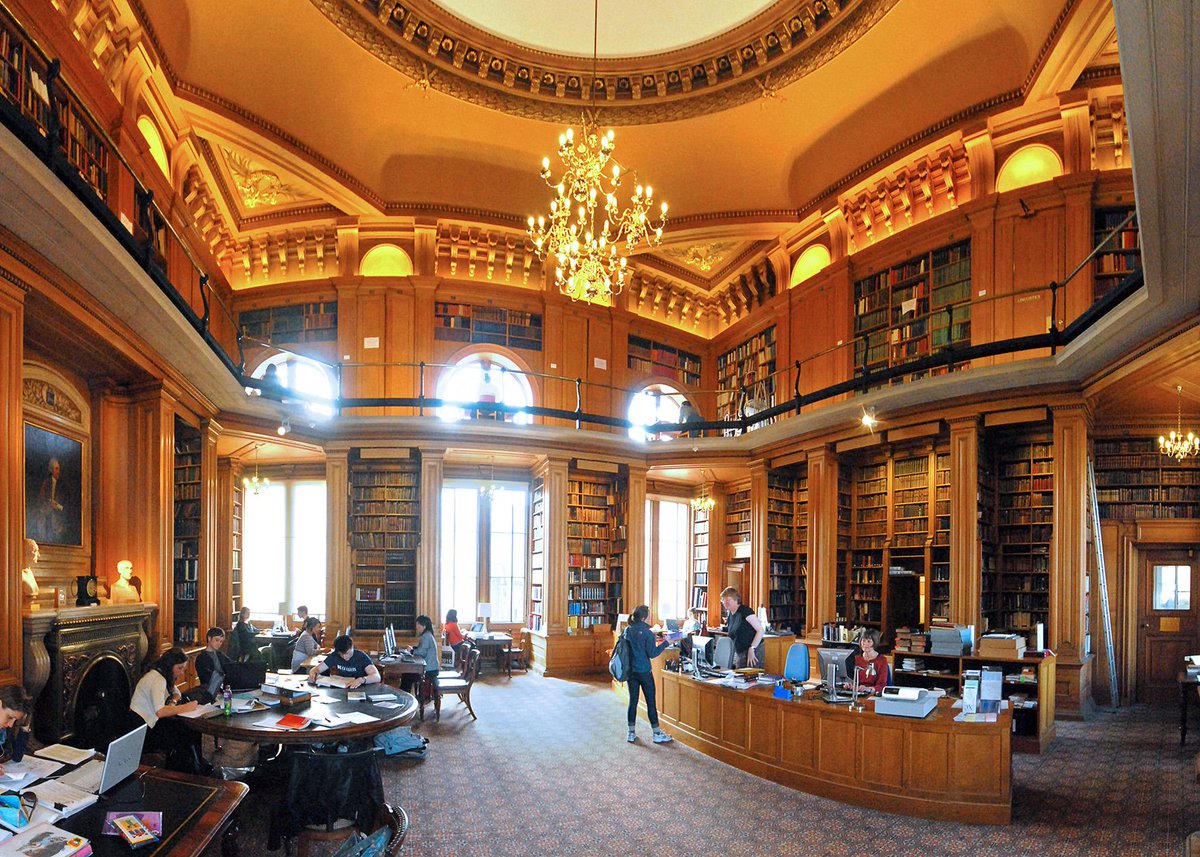
The Great Library of the Bookworld is too big to be captured in a picture. Maybe we can get a glimpse from looking at photos of libraries from around the world:

Baroque Library, PragueThe Baroque library hall inside Clementinum, Prague, Czech Republic
(Photo: Bruno Delzant, from Wikipedia)

Bibliothèque Interuniversitaire de la Sorbonne, Paris close
Bibliothèque Interuniversitaire de la Sorbonne, Paris
(Photo: Franck Bohbot, featured on BBC Culture)

OxfordUniversity
Oxford University Library
(Photo: Oxford University, featured on Twitter by@UniofOxford)

NYC Public Library
NYC Public Library Research Room
(Photo: Diliff, from Wikipedia)

Boston Public Library
(Photo: Franck Bohbot, featured on BBC Culture)

Reading Room at McKim Building
Reading Room in Boston Public Library, McKim Building (research collection)
(Photo: Brian Johnson, from Wikipedia)

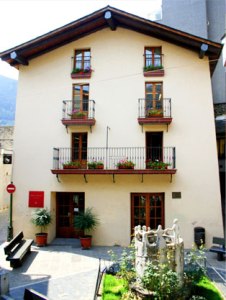
Perhaps the cutest (and most inviting) one is the National Library of Andorra

BNA


Posted in fiction, photos | Tagged , | 4 Comments

Emmy Noether: the mathematician who discovered the connection between Symmetry and Conservation Laws

“It is only slightly overstating the case to say that physics is the study of symmetry.”
P.W. Anderson (Nobel Prize in Physics 1977)
More is Different“,
Science, 177, 4047 (1972).

By symmetry, Anderson writes, “we mean the existence of different viewpoints from which the system appears the same.”

According to The Feynman Lectures on Physics,  Hermann Weyl gave this definition of symmetry: a thing is symmetrical if one can subject it to a certain operation and it appears exactly the same after the operation. For instance, if we look at a silhouette of a vase that is left-and-right symmetrical, then turn it 180∘ around the vertical axis, it looks the same.

Water drops, snowflakes, and crystals are examples of natural objects with symmetries. But symmetries in nature are not limited to objects. They exist in the basic laws which govern the physical world.

What does it mean that a physical law is symmetrical?

For example, let’s look at symmetry under translation in space and in time.
Experiments are routinely done at different labs around the world. Symmetry under translation in space means that the outcome of an experiment is independent of where it is done as long as all the relevant conditions are the same.

Experiments are also conducted at different times. Symmetry under translation in time means that their results are the same (assuming that the measurements do not depend on seasons and such). In fact, “different times” can be billions of years apart.

For each of the rules of symmetry there is a corresponding conservation law:

  • Symmetry under translation in space means that momentum is conserved.
  • Symmetry under translation in time means that energy is conserved.

For other important examples see The Feynman Lectures on Physics.

Quite surprisingly, the connection between symmetries in space and time and the fundamental conservation laws were not known during the nineteenth century, nor at the beginning of the twentieth. In a paper “E. Noether’s Discovery of the Deep Connection Between Symmetries and Conservation Laws”, Nina Byers follows the history of the discovery. Here is a shortened (and non-mathematical) version.

In 1915, Emmy Noether was invited to join the team of mathematicians assembled in Göttingen by David Hilbert. Shortly after she arrived, Albert Einstein gave six lectures in Göttingen, on the general theory of relativity. At that time the theory was not yet finished. However, the basic ideas were clear and his audience found them compelling. Although the general theory of relativity was completed in 1915, there remained unresolved problems. One of them was the principle of local energy conservation. In the general theory, energy is not conserved locally as it is in classical field theories – Newtonian gravity, electromagnetism, hydrodynamics, etc..

Hilbert asked Noether to look into the problem. Consequently, she began to study relativity theory. Out of that study came two papers which Hermann Weyl characterized as giving “the genuine and universal mathematical formulation of two of the most significant aspects of general relativity theory.”
Noether’s first theorem, which she proved in 1915, but did not publish until 1918, not only solved the problem for general relativity, but also determined the conserved quantities for every system of physical laws that possesses some continuous symmetry.

Upon receiving her work, Einstein wrote to Hilbert:

“Yesterday I received from Miss Noether a very interesting paper on invariants. I’m impressed that such things can be understood in such a general way. The old guard at Göttingen should take some lessons from Miss Noether! She seems to know her stuff.”

To get a more colorful account about Neother’s years at the University of Göttingen, I recommend to read “Women in physics in Fermi’s time”, also by Nina Byers.
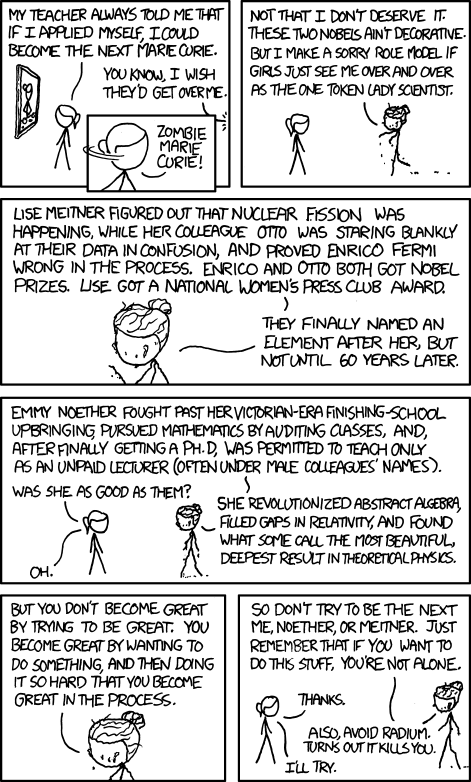
To get the idea how is was, here is an xkcd cartoon


Posted in physics | Tagged , , , | 2 Comments

Book reviews for self-published fiction

“But there certainly are not so many men of large fortune in the world, as there are pretty women to deserve them.”
Jane Austen, Mansfield Park.

To paraphrase Jane Austen, there certainly are not so many book-reviewers in the world, as there are novels to deserve their attention. A lot has been written about getting reviews for self-published books. In this post I summarize what I’ve learned so far.

An overview:

IndieBookLauncher has a page, titled “Getting Your Indie Book Reviewed”, that discusses “Why Do Reviews Matter?”. It considers reputable companies, like Kirkus Indie Reviews and Blue Ink Review, that review self-published books for a fee. It also points to venues that don’t charge a fee. Under the umbrella of “Getting Reader Reviews on Book Vendor Sites”, it lists book giveaways on Goodreads (only for print books ) and on LibraryThing (both ebooks and paper books; however, not applicable for free ebooks), Shelfari’s free ebooks group, Amazon’s KDP Select Program and Kubo’s promotions. There are also links to blogs and discussion boards.

Reviews by reviewers

The Indie Reviewers List provides links to websites that review self-published books for free. The websites are listed alphabetically according to reviewer’s name. The list indicates which genres each website reviews and where the reviews are posted.

Reviews by readers

  • IndieBrag (Book Readers Appreciation Group) focuses on fiction. Self-published authors can suggest an ebook for consideration (this requires a non-refundable payment of $20.00). According to the cite, “On average, 50% of the books submitted to us fail to pass the initial screen and another 40% are subsequently rejected by our readers. Thus, only 10% of the books we consider are awarded our B.R.A.G. Medallion and are presented on our website.

  • Goodreads Authors/Readers. This big group (almost 20,000 members) of readers and Goodreads authors is divided by genres. Authors can introduce their books, ask for reviews, announce giveaways. There are also threads to book review blogs and other resources.

  • An advice by Catherine Ryan Howard, the author of Self-Printed:
    Find the book’s (that is similar to yours – TK) Goodreads page and contact the users who gave it 5* and are accepting messages. (You can send private messages to non-friends but they are limited to I think around 12 a day). Offer them a complimentary copy of your book to review.
    (See more advice here).

Reviews by other indie-authors

  • GOOD REVIEWS is a Goodreads group where authors who are looking for reviews can post their books for review.

  • Review Group is a Goodreads group where authors get reviews from other author members, and in turn give non-reciprocal reviews to other authors in their reviewing group. In each round a member reads and reviews four allocated books. Reviewers cannot choose the books they get for review. There are three types of groups. General includes all genres of fiction, “from literary works, children’s books, and poetry to horror and erotica” and all non-fiction. Clean – with absolutely NO explicit sex, NO violence. And 18, where one will predominantly be reviewing books with explicit sex and/or violence.

  • The Reviews Initiative for Indie Books is a Goodreads group open to authors willing to read and review an Indie author’s book, and post their review on Amazon and Goodreads. In return, a different author agrees to read and review your book. You can choose whether to take the current offer for review, or wait for another book, but you don’t know who is going to review your book.


  • If you know of other review sites, blogs or groups, please share the information in the comments.


Posted in fiction, self-publishing | Tagged , , , , , | Leave a comment

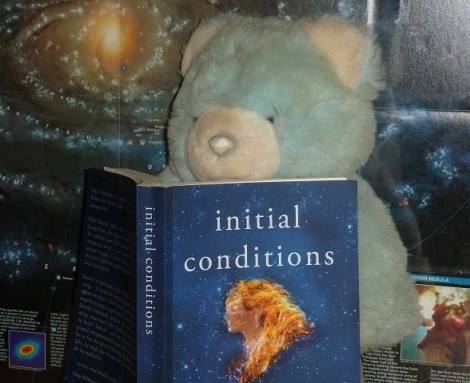
Initial Conditions paperback – first view

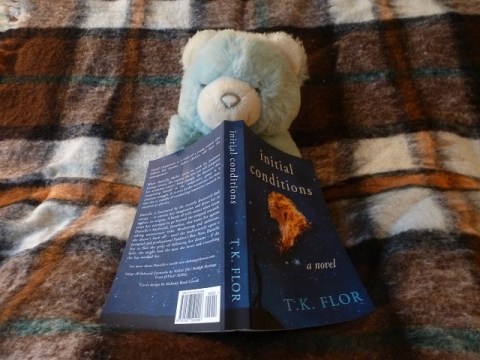
The proof copy of Initial Conditions paperback has finally arrived.

PKa
PKb
PKc
PKd


Posted in fiction, mainstream fiction, photos, self-publishing | Tagged | 1 Comment

Professors in children’s books

I was looking for information on how women scientists are portrayed in fiction when I found a blog post by Melissa Terras (professor at University College London) on how children’s books portray scientists and other academics.
Here is an excerpt:

What are academics in children’s books like?
The 108 academics found consist of 76 Professors, 21 Academic Doctors, 2 Students, 2 Lecturers, 1 Assistant Professor, 1 Child, 1 Astronomer, 1 Geographer, 1 Medical Doctor who undertakes research, 1 researcher, and 1 lab assistant. In general, the Academic Doctors tend to be crazy mad evil egotists (“It’s Dr Frankensteiner – the maddest mad scientist on mercury!”), whilst the Professors tend to be kindly, but baffled, obsessive egg-heads who dont quite function normally.

The academics are mostly (old, white) males. Out of the 108 found, only 9 are female: 90% of the identified academics are male, 8% are female, and 2% have no identifiable gender (there are therefore much fewer women in this cohort than in reality, where it is estimated that one third of senior research posts are occupied by women).  They are also nearly all caucasian: only two of those identified are people of colour: one Professor, and one child who is so smart he is called The Prof: both are male: this is scarily close to the recent statistic that only 0.4% of the UK professoriat are black. 43% of those found in this corpus are are elderly men, 33% are middle aged (comprising of 27% male and 6% female, there are no elderly female professors, as they are all middle age or younger). The women are so lacking that the denoument of one whodunnit/ solve the mystery/ choose your own adventure book for slightly older children is that the professor they have been talking about was actually a woman, and you didn’t see that coming, did you? Ha!

.chart.

The earliest published academic in a children’s book found was in 1922 (although its probable that the real craze for featuring baffled old men came after the success of Professor Branestawm, which was a major international bestseller, first published in 1933, and not out of print since). The first woman Professor found is the amazing Professor Puffendorf – billed as “the world’s greatest scientist” -,  published in 1992, 70 years after the first male professor appears in a children’s book. 70 years (although it is frustrating that the book really isn’t about her, but what her jealous, male lab assistant gets up to in her lab when she goes off to a conference. More Puffendorf next time, please). There is also a more recent phenomenon of using a Professor as a framing device to suggest some gravitas to a book’s subject, but the professor themselves does not appear in any way within the text, so its impossible to say if they are male or female.  Male Professors in children’s books have appeared much more frequently over the past ten years: women not so much.

Here is the link to the blog, titled Male, Mad and Muddleheaded: The portrayal of academics in children’s books is shockingly narrow.

I highly recommend to read the entire blog. I found the last section, titled “Why is this relevant?”, to be especially thought-provoking. You can see why, from this excerpt:

That said, the difference in gender, and how women and men are represented, and the underepresentation of those who are anything but white in children’s books about academia, is shocking, especially given that almost all scientific fields are still dominated by men, and women are frequently discriminated against and although 46% of all PhD graduates in the EU are female, only 1/3 of senior research posts are occupied by women. At a time when researchers are asking if available toys can influence later career choice, can the same be said about books? At a time when it is becoming the parents’ job to encourage girls into science and technology – and to educate all children about science and engineering careers – does the lack of anything but white, old men as academics in children’s books reinforce the impossibility of anyone other than those making a contribution? At a time when the leaky pipe of academia shows that women are leaving in droves at every level of the academic ladder, should we be worried that there are no female academics in children’s books above middle age?


Posted in fiction | Tagged , , , , , | 2 Comments

FARADAY, MAXWELL, and the ELECTROMAGNETIC FIELD

FMEF

“From the time of Newton, leading scientists had believed that the universe was governed by mechanical laws: material objects held energy and inflicted forces. To them, the surrounding space was nothing more than a passive backdrop. The extraordinary idea put forward by Faraday and Maxwell was that space itself acted as a repository of energy and a transmitter of forces: it was home to something that pervades the physical world yet was inexplicable in Newtonian terms – the electromagnetic field.”

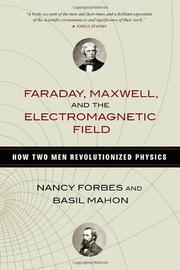
FARADAY, MAXWELL, and the ELECTROMAGNETIC FIELD, by Nancy Forbes and Basil Mahon.

As the title of the book suggests, FARADAY, MAXWELL, and the ELECTROMAGNETIC FIELD are the three main characters. Michael Faraday was the brilliant experimentalist who first came up with the concept of the electromagnetic field. James Clerk Maxwell was the genius theoretician who formulated the laws of electrodynamics and showed that electromagnetism and light were manifestations of the same phenomena. The discovery of Electromagnetic Field has transformed our world.

The first chapter introduces a thirteen-year-old Michael Faraday, an apprentice bookbinder with a keen interest in how electricity works. In an astounding turn of events, young Faraday, who had little formal education, became an assistant to Humphry Davy, the greatest man of science in Europe. Reading on, one gets a glimpse into the new world Faraday joined – he met with Europe’s leading scientists, and yet Davy’s wife treated him like a servant, because of the British class system. The real story, however, begins after a concise survey of the history of electricity and magnetism since the 1600s. Most notable were the discoveries made by Ørsted and Ampère, that related between magnetism and electric currents – they changed the course of Faraday’s career.

The book describes and explains Faraday’s groundbreaking experiments, and overviews the painstaking work he did. It points not only at his famous successes, but also to his failures. Most interesting is the way it tracks the slow evolution of Faraday’s notion of lines of force. Knowing what we know today, it is weird that

“Despite the universal acclamation of Faraday’s scientific work, his greatest achievement had been largely ignored during his lifetime, and was only beginning to surface at the time of his death.”

But it’s interesting to find out why Faraday’s lines of force were not taken seriously by his contemporaries, who adhered to the widely accepted Newtonian concepts of action at a distance. Moreover, one starts to see why it took the genius of Maxwell to fully understand Faraday’s greatness.

As the book’s focuses on James Clerk Maxwell, it shifts to the world of lairds in early Victorian Scotland. Unlike Faraday, who barely had any formal education, young Maxwell was educated at Edinburgh Academy, one of the best schools in Scotland. He published his first mathematical paper at the age of fourteen. At nineteen, Maxwell was already an experienced scientific experimenter and had published three mathematical papers. He was ready to leave Scotland for “the society and drill” of Cambridge.

The portrayal of Maxwell’s years at Cambridge pictures the world of bright, privileged, and often ambitious young gentlemen. It also gives insight into how the prodigy boy became one of the greatest physicists of all time. An illuminating example is Maxwell’s introduction to Faraday’s work:

“Scanning the books and papers that Thomson had recommended, Maxwell soon saw that the state of knowledge about electricity and magnetism was unsatisfactory. Much had been written, but each leading author had his own methods, terminology, and point of view. All the theories except Faraday’s were mathematical and based on the idea of action at distance. Their authors had largely spurned Faraday’s notion of lines of force because it couldn’t be expressed in mathematical terms,…”

Contrary to what one might have expected, Maxwell, the natural mathematician, was drawn to work on Faraday’s concept.

It took nine years for Maxwell to develop his theory. Nancy Forbes and Basil Mahon take the reader through Maxwell’s personal and scientific milestones during that period. What I learned is that Maxwell was shunned repeatedly by Scottish universities even though he was one of the most prominent figures in nineteenth century science. That makes one wonder, what would physics have looked like if Maxwell was not independently wealthy, and couldn’t work on his magnum opus at his estate Glenlair?

The authors discuss the various steps Maxwell took while developing his ideas, and use diagrams to visualize his process of thinking. They do not dwell on the mathematics, but describe the results summarized in Maxwell’s equations, then explain what was so revolutionary about the new theory.

The last part of the book is about the evolution of the theory of electromagnetism after Maxwell.

“In the story of electromagnetic field, Maxwell was a lone actor in his time, just as Faraday had been in his. Not until the following generation did anyone else truly understand what Faraday and Maxwell had been trying to tell them. The way was then led by a small band of individuals…”

Not quite surprisingly, the story goes on, and one meets the who’s who in the physics of the early twentieth-century.

Do I recommend the book?
Yes. The authors’ admiration for Faraday and especially Maxwell shines through the pages, and it doesn’t spoil the reading. After all, these two men were giants, and also well-grounded and very decent human beings. Some of the descriptions of Faraday’s experiments and Maxwell’s “cells” and “wheels” were too lengthy to my liking, but reading about the incubation and the evolution of one of the most fundamental concepts in physics more than compensated for it.


Posted in physics | Tagged , , , , | Leave a comment

The Hungry Boson

So, what is the Hungry Boson?
Join Danielle, the protagonist of Initial Conditions, as she finds out.

    The buildings facing Stateside Street were law firms and real estate offices, boutiques and an upscale barbershop. Parched and annoyed at not being able to find her way in a small town, Danielle was slow to distinguish a new scent wafting in the warm air, an elusive aroma that intensified as she walked down the street. A whiff of the tantalizing mixture brought to Danielle’s mind freshly baked cakes, summer berries, and melted chocolate.
    “A fantasy,” she dismissed the thought, but quickened her pace. A bakery shop would have cold bottled water and fresh muffins and brownies, maybe a few tables.
    Danielle’s nose twitched when she reached a single-story house. Her mouth watered, so seductive was the scent engulfing her. On a sign above the door, she read “The Hungry Boson.”
    A strange name for a café or a bakery, Danielle thought. For a while, she just stood there and inhaled the smells that floated around, tickled her nostrils. Then she stepped inside.
    Shaded from bright light, Danielle saw lace curtains drawn on windows , wooden round tables, and wide flowery chairs that belonged to an old-fashioned teashop. Buttery scents, fruity scents, and heavier chocolaty aromas swirled and glided all over. She inched forward; her eyes grew bigger and bigger as her stare shifted from an espresso machine to trays laid on refrigerated shelves. No muffins. No brownies. She gaped at neatly arranged éclairs, pies and tarts.
    “A lovely day, isn’t it?” a woman’s voice came from the back of the shop. Glancing in that direction, Danielle glimpsed an elderly woman put a book aside and walk to the counter.
    “How can I help you?” the woman asked. Her voice was friendly, its light accent matching the teashop ambiance.
    “It’s so beautiful here,” Danielle said. “Can I get a cappuccino and a glass of water?” She turned her head towards a distant tray. “And one of these éclairs, please?”
    Danielle gulped the water while drops of coffee slowly dripped into a cup. Her curious stare flitted from object to object, until it paused on a couple of newspapers at the edge of the counter.
     “The King’s Monkey?” Danielle read aloud. “Is it a local newspaper?”
    “The Monkey is a satirical students’ paper,” the woman replied.
    “Hopeville Herald?” Danielle read another title.
    “Plenty of gossip, and some university news.”
    The woman put the coffee on the counter. “Drink carefully when you are reading,” she advised.
    The coffee and the chocolate éclair were excellent. Reading about a professor in a Martian barbershop, Danielle felt at peace with herself and the world. She did not notice other customers walking in.

Excerpt from chapter 1 of Initial Conditions, © T. K. Flor, 2015.

cup-of-coffee


Posted in fiction, lab lit, literature, mainstream fiction, self-publishing | Tagged , | Leave a comment

Stars and dreams

Initial Conditiions

“I confess I do not know why, but looking at the stars always makes me dream.”
Vincent van Gogh

“Love what you do and do what you love. Don’t listen to anyone else who tells you not to do it.”
Ray Bradbury

Vincent van Gogh looked at the stars, dreamed, and painted his dreams. He became a renowned Post-Impressionist painter. His work – notable for its rough beauty, emotional honesty, and bold color – had a far-reaching influence on 20th-century art. He drew most of his paintings during the years he suffered from painful anxiety and frequent bouts of mental illness. He died at the age of 37.

Ray Bradbury looked at stars, dreamed, and wrote his dreams. He became one of the most celebrated 20th-century American writers. His dystopian novel about book-burning futuristic society, Fahrenheit 451, has withstood years of expurgation by its publisher, and is still widely read today (#524 in Books at Amazon, as of time writing this post). He was happily married and had four daughters. He died at the age of 91.

It is tempting to look at the stars and dream.
Following the dreams is another story…

In biographies of famous people (for example Steve Jobs by Walter Isaacson), following dreams leads to success. In fiction, the outcome of following dreams depends on the genre. In romance, love is the prize, and one will be living happily ever after. In thrillers and other genres with violence, the bad guy is the one who follows his megalomaniac dreams. The villains are selfish and destructive to others – their dreams must be thwarted, and they must end up defeated. In tragedies, the hero loses everything.

For me, not knowing beforehand how things will turn out is a good reason to pick a book and start reading. Not coincidentally, I wrote the kind of book I would like to read – about looking at stars and following one’s dreams.
Here is a teaser (the blurb):

When Danielle Meller starts to work for professor George Green, she expects the new job will jumpstart her academic career. Soon enough, she discovers that integrating herself in the competitive group is a constant struggle. It is even harder to convince her boss that she is capable of conducting innovative research in theoretical physics.

Danielle is fascinated by the recently discovered dark energy – it entices her imagination and draws her to explore its origins. A battle of wills ensues when Green stops her attempts to go beyond the assigned research. Danielle’s boyfriend, Jonathan, also warns her against taking unnecessary risks. Headstrong and ambitious, she doesn’t back off – until she inadvertently opens a personal and professional Pandora’s Box. Now, Danielle has to face the price of following her dreams – if she fails, she might lose the man she loves and everything she has worked for.

From the back-cover of Initial Conditions, a soon-to-be-published novel.

Update: Initial Conditions is published!


Posted in cosmology, fiction, mainstream fiction, physics, self-publishing, writing | Tagged , , , | Leave a comment

From outer space to a book cover

   “But you are resolved to pursue it right now. Are you ready to gamble on your career, going boldly where no one else cared to go before?”
“You paraphrased the wrong movie. I’m neither the first nor the only one who seeks the origins of dark energy. A more adept one-liner would be ‘trust your feelings’.”
Initial Conditions, T. K. Flor

Yes, T. K. Flor is me, and Initial Conditions is the name of my first novel. The allusions are, respectively, to Star Trek and Star Wars. The excerpt is from a conversation between Jonathan and Danielle. As most of you haven’t met them yet, I’m going to make the introduction, and also tell the story of my novel’s cover.

A disclaimer first. Initial Conditions isn’t science fiction, nor fantasy. Even though the quest to find the origins of a mysterious dark energy plays an important role in the story, dark energy is not an evil force stalking in the darkness, waiting for a reckless protagonist. So what is dark energy? Actually, no one knows. This enigmatic energy permeates all of space (even here on Earth). It pushes physical objects apart, but its menacing effect is measurable only at length-scales much larger than a galaxy. Even with a hyperdrive, such mind-boggling distances would be unmanageable (read why).

Back to the story, and its leading characters. The protagonist is a physicist, whose field of research is cosmology. Danielle is twenty-seven, headstrong and ambitious. Even though her boss disapproves her intuitive leaps, and her boyfriend tries to dissuade her from taking unnecessary risks, she follows her dreams, and inadvertently opens a personal and professional Pandora’s Box.

Initial Conditions is a contemporary mainstream novel. Genre-wise, that means that (a) it is set in the last few decades (actually in the years 1999-2000), (b) it doesn’t fit into a specific genre (not a science fiction, a thriller, a mystery…), and (c) its tone isn’t literary. As so many very different books fall into this category, the common ground between them is usually what they aren’t about.

Since I already wrote about lab-lit and science in fiction in a previous post, I focus here on the book cover. According to every self-publishing guide I’ve read, it is a must to have an appealing and relevant cover. Here is what Self-printed: the sane person’s guide to self-publishing (3rd edition), by Catherine Ryan Howard, says:

Say it with me, people: genre is a shortcut to sales. Whether it happens subconsciously or consciously, pushing your book into a genre and then creating a cover that makes it look at home there is cutting by half the distance between your book on sale and a copy of it sold. Don’t be precious. Be smart. Start by identifying which genre your book belongs in.

To give potential readers of the novel a better idea of what to expect, I intended to put on the cover an image of a galaxy, or of a sky studded with stars. Then I learned that while illustrated starry-night was okay, a realistic image might not be such a good idea. People have certain expectations about book covers, and a photo from outer space might mislead them to think that Initial Conditions is science fiction. Unexpectedly, I was faced with a dilemma. I felt there should be a reference to space on the cover. But how much risk was it worth to take?

One day, while looking at pictures from NASA, I found an image that I really liked:
PIA04609
Image credit: NASA/JPL/Hubble Heritage Team (STScI/AURA) (link).

The original caption released with image, said:

Resembling sparks from a fireworks display, this image taken by a JPL camera onboard NASA’s Hubble Space Telescope shows delicate filaments that are sheets of debris from a stellar explosion in the nearby Large Magellanic Cloud galaxy.

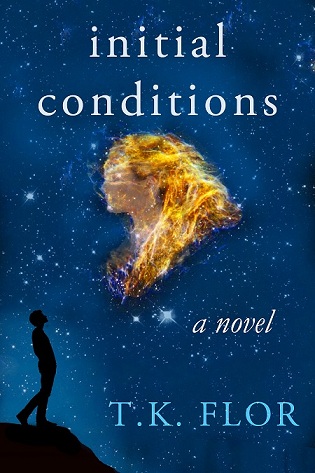
To me, the filaments look like a face of a woman, made out of exploding stars. I stared at it for a while, left it, and came back to stare more. The image fitted the story as if someone had designed it after reading the entire book. It also appealed that the picture was taken by the Hubble Space Telescope. Maybe it’s irrational, but it means something to have on my work of fiction an image captured by Hubble. To put it in context, here is some background:

Hubble has shown us some of the universe’s earliest galaxies and defined the limits of their age. Its vision has uncovered evidence of black holes and discovered the mysterious, unexplained phenomenon called dark energy.
(From hubblesite.org)

… two teams initially began their Hubble observations of far-flung supernovae to measure the deceleration of the universe due to the pull of gravity. To their amazement, they found the opposite; the universe was expanding at an ever-faster rate. Astrophysicists have hypothesized that an unknown phenomenon, called dark energy, is causing the acceleration. The discovery, first announced in 1998, is one of the biggest surprises in science and has earned Riess, Perlmutter, and Schmidt many accolades, including the Nobel Prize in Physics.
(From hubblesite.org)

How can one pass such an opportunity? On the other hand, I’ve invested years writing (and rewriting) Initial Conditions. I didn’t want to make a wrong impression that might drive away potential readers before they start reading. Good grief! It dawned on me why trad-publishers rarely involved their authors in decisions concerning the covers of their books. It also clued me as to why some book-cover designers do not like to work with first-time indie authors. Since I have already contacted Keri at Alchemy Book Covers and she did ask for my input, I sent her the link to the image, and asked whether she could retouch it to make the face more woman-like. I also asked whether she could use it for a contemporary-mainstream-fiction type book-cover. She emailed me back, saying she would look at it.
And she did.

ICcover315x473


Posted in cosmology, fiction, lab lit, literature, mainstream fiction, photos, physics, science fiction, self-publishing | Tagged , , , , | Leave a comment

Jane Austen’s birthday

Jane Austen was born on December 16, 1775, in rural Hampshire, England. She had little formal education, never traveled outside England, and never married. She published four novels – Sense and Sensibility (1811), Pride and Prejudice (1813), Mansfield Park (1814) and Emma (1815). She died at the age of 41. Two other novels. Northanger Abbey and Persuasion, were published after her death.

Although the couples Jane Austen created are among the best-known pairs in English literature, in my experience, men and women react differently when Jane Austen’s name is mentioned. The gender which is more likely to sneer at those who admire Jane Austen’s characters, is also the gender which is less likely to have actually READ any of her novels (by read I mean not watched a movie, nor read an excerpt or a Wikipedia article).

Here are three examples of the banter her couples exchanged. At the end are the names of the corresponding novels.

  1. “I certainly have not the talent which some people possess,” said Darcy, “of conversing with those I have never seen before. I cannot catch their tone of conversation, or appear interested in their concerns, as I often see done.”
    “My fingers,” said Elizabeth, “do not move over this instrument in the mastery manner which I see so many women’s do. But then I have always supposed it to be my own fault – because I would not take the trouble of practicing. It is not that I do not believe my fingers as capable as any other woman’s of superior execution.”

  2. “I’m ready,” said Emma, “whenever I am wanted.”
    “Whom are you going to dance with?” asked Mr. Knightly.
    She hesitated a moment, and then replied, “With you if you will ask me.”
    “Will you?” said he, offering his hand.
    “Indeed I will. You have shown that you can dance, and you know we are not really so much brother and sister as to make it at all improper.”
    “Brother and sister! No, indeed.”

  3. “You have not been long enough in Bath,” said he, “to enjoy the evening-parties of the place.”
    “Oh! no. The usual character of them has nothing for me. I am no card-player.”
    “You were not formerly, I know. You did not use to like cards; but time makes many changes.”
    “I am not yet so much changed,” cried Anne, and stopped, fearing she hardly knew what misconstruction.

  1. Pride and Prejudice
  2. Emma
  3. Persuasion
Posted in fiction, literature | Tagged | Leave a comment