
“You should know how many incompetent men I had to compete with —
in vain”
Inge Lehmann.
Quips aside, Inge Lehmann was a pioneering seismologist who discovered that the Earth has both an inner and an outer core. Continue reading
“You should know how many incompetent men I had to compete with —
in vain”
Inge Lehmann.
Quips aside, Inge Lehmann was a pioneering seismologist who discovered that the Earth has both an inner and an outer core. Continue reading
“You seem to want to write, so write…
Even if only the people in your writing group read your memoirs or stories or novel, even if you only wrote your story so that one day your children would know what life was like when you were a child and knew the name of every dog in town – still, to have written your version is an honorable thing to have done. Against all odds, you have put it down on paper, so that it won’t be lost. And who knows? Maybe what you’ve written will help others, will be a small part of the solution.”
Bird by Bird, Some Instructions on Writing and Life, Anne Lamott
“One of the hardest things I’ve had to learn as a writer is that while virtually any story can be a good book if done correctly, not every story should. It’s possible to have an amazing idea and still lack the interest necessary to polish it to publication level shine. I can not tell you the number of books I’ve plotted, written 30k words in, and then abandoned because I simply could not stand to look at them another second. Every single one of these ideas looked great on paper, and maybe in another author’s hands they could have been golden, but in the end I just didn’t care enough to push through. As someone who makes her living through writing, these stalled books are doubly disappointing. I’m pretty fast now at plotting and writing, but each of those stories still took time and work that I will never be paid for. It’s like working a job for a month only to find out at the end that you’re not getting a check. Even if you enjoyed yourself and everyone had the best intentions, you can’t afford to work for free.”
2k to 10k: Writing Faster, Writing Better, and Writing More of What You Love, Rachel Aaron.
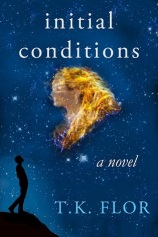
Once upon a time (about half a year ago), I thought that there were two types of writers: aspiring writers and published (by which I also include self-published) writers. For years, I worked on one story I was passionate about. By mid-January, I held a physical copy of Initial Conditions. Yes, it was exhilarating. After a decade of writing and rewriting, it was no longer a story I wrote “so that it won’t be lost”. It became a real book, available to be read far beyond my writing group and family circle. For the first time I felt like an author.
After a couple of weeks, the dazzled expression of a freshly minted “author” started to wear off my face. I began wondering, “What’s next?” I had more to tell about Danielle, Jonathan and certain professors from King Solomon University. I wanted to continue writing, but I lost that starry-eyed outlook that drove me to complete and then publish a novel.
I was on vacation during the spring break. When I came back, I tried to resume writing. To say it gently, the meager word count was the least of my problems. What I wrote was boring and made little sense. Even worse, when writing, I felt that I’ve already told the story I was meant to tell, that anything I’d write will be like reheating leftovers. I shifted my focus to “research”, which is a convenient term for procrastination.
Nothing worth telling happened until a very wise guy sagely suggested that I’d try to write something completely different. Something that wouldn’t take very long, and have a wider appeal. This idea seemed so ingenious I asked him if he borrowed it from The Cinema of George Lucas (“During the production of THX Coppola challenged Lucas to try to write something ‘warm and fussy’ for his next project, and Lucas embraced the idea.” The outcome was American Graffiti.) The very wise guy said that it’s just common sense.
While I was looking for an exiting subject to write about, David Gaughran blogged about what it takes to move on to the next level of writing fiction. Following his recommendation, I bought Rachel Aarons’s 2k to 10k. This short book (which I also recommend) explained to me why Initial Conditions took so long, and offered some remedies. (In a nutshell, it showed that one can write much faster by knowing what to write before writing it. Another way to boost writing is to do it daily, during one’s prime writing time.) David Gaughran’s post and Rachel Aaron’s book also made me realize that a hobbyist and a professional writer differ not only in the amount of books they write and sell. The entire premise seems to be different. A hobbyist writes what s/he wants to read, when s/he feels inspired. A professional writes constantly and fast, with a target audience in mind (that also explains the prevalence of series in popular genres).
It gave me some food for thought, but did not guide me as to how I to combine what I’m enthusiastic about with writing in a popular genre. What may be more relevant is Aaron’s advice on increasing productivity:
“There are many fine, successful writers out there who equate writing quickly with being a hack. I firmly disagree. My methods remove the dross, the time spent tooling around lost in your daily writing, not the time spent making plot decisions or word choices. This is not a choice between ruminating on art or churning out novels for gross commercialism (though I happen to like commercial novels). It’s about not wasting your time for whatever sort of novels you want to write.”
I don’t know whether the prospect of becoming a hack deters anyone, but it certainly wouldn’t bother me. Asimov was a very prolific writer. Like hoards of his other fans, I read and reread his stories, without caring whether it took him hours or years to write. Those who worry about “literary” whatsoever, here is what Stephen King wrote on “How much writing constitutes a lot?” (from On Writing):
“That varies, of course, from writer to writer. One of my favorite stories on the subject – probably more myth than truth – concerns James Joyce. According to the story, a friend came to visit him one day and found the great man sprawled across his writing desk in a posture of utter despair.
“James, what’s wrong” the friend asked. “Is it the work?”
Joyce indicated assent without even raising his head to look at the friend. Of course it was the work; isn’t it always?
“How many words did you get today?” the friend pursued.
Joyce (still in despair, still sprawled facedown on his desk): “Seven.”
“Seven? But James… that’s good, at least for you.”
“Yes,” Joyce said, finally looking up. “I suppose it is… but I don’t know what order they do in!”
 Issac Asimov |
 James Joyce |
According to King, a reasonable goal is writing at least a thousand words per day, at least six times a week. What about not having inspiration? “Don’t wait for a muse.” King advises. Writing should be treated just as “another job like laying pipe or driving long-haul trucks. Your job is to make sure the muse knows where you’re going to be every day from nine ’til noon or seven ’til three. If he does know, I assure you that sooner or later he’ll start showing up, chomping his cigar and making his magic.”
Even though King doesn’t say so, his advice seems what distinguishes a pro from a hobbyist. If one can sustain this kind of writing for years, s/he becomes professional.

“No one can be really esteemed accomplished who does not greatly surpass what is usually met with.”
Jane Austen, Pride and Prejudice.
It has been over two hundreds years since Miss Bingley made this snooty assertion, and yet her sentiments seem today just as relevant as the latest iPhone. To be “esteemed” (or even to have job-security in a society buffeted by the advent of disruptive technologies and the swings of financial markets), one is expected to “surpass what is usually met”. As the title of this post suggests, this trend begins at a very young age.
I was catching up with blog-posts accumulated on my reader during a vacation, when it occurred to me that there aren’t as many posts as one might expect during the A–to–Z challenge (it requires one to blog about a theme every day, except Sundays, throughout April). As Tara Sparling predicted, I appreciate that there weren’t hundreds of posts in my reader. Being still in a “vacation mood”, this post is a twist on the A–to–Z challenge – it presents one eminent physicist for every letter of the alphabet (for letters like “c” and “w” I chose from several names, while letters “q” and “x” were challenging). Continue reading
“If this is about anything, it’s the boundary between creation and madness, art and science, the natural and the artifactual. Characters are fictional although some are inhabited by amalgamated aspects of real people. The science is factual but I insert plausible speculation in places.”
Chris Impey, from preface to Shadow World.
Real science in a contemporary novel written by an astronomer whose research focuses on observational cosmology – such a book should have popped in searches I did for novels with realistic physics and in the automated book recommendations I routinely get. Nevertheless, I did not hear about professor Impey’s books until I visited his website. There I learned that along with his research, Impley pioneered curriculum development in astrobiology, published astronomy textbooks, explored issues at the crossroads of science and religion, and also published six popular science books and one novel, the Shadow World. As a reader, I was intrigued by the vast expanse Shadow World seemed to offer. As a writer, I was curious to find out how Impey incorporated science in a novel.
Shadow World has an unusual structure for a novel. It is written in seven episodes, all narrated by the main character: a Scot named McEvoy. (“Just that. McEvoy. Nobody calls me Ian but my sis; even my mum calls me McEvoy.”)
The first episode takes place in Arizona desert. McEvoy is nineteen years old, a curious young man with somewhat faulty memory. McEvoy’s unquenchable thirst for knowledge singles him out. He is an adventurer, a seeker who ventured the into the majestic Grand Canyon in a search for hidden meaning. In his quest, McEvoy follows a mentor-trickster, a Navajo guide with a checkered past and questionable trustworthiness.
The second episode takes place in New York City. McEvoy is twenty-five, but he’s still brimming with promise. Even though he clearly has some mental problems, he is bright and gushing. He finds a new mentor. He also finds a partner for both sex and intellectual adventures – a beautiful woman with a French accent, who happens to be doing a PhD in astrophysics at Columbia University.
The third and forth episodes take McEvoy to China and to Patagonia, respectively. Both times he ends up in archeological excavations, but with very different outcomes.
McEvoy is about thirty when he finds himself in the Emerald Island (fifth episode). In Belfast, he reads about a “lecture series at the Armagh Observatory on astrobiology, the study of life in the universe.” Since he has a soft spot for astronomy, he hops on a bus to Armagh and attends the lecture. Intrigued, he joins an invitation-only research symposium. How? “… nobody’s manning the registration desk so I pick up a packet and a blank name badge and invent an academic affiliation for myself.”
I did not expect what followed next.
At coffee, a man wearing a blazer and clubby tie approaches. “I don’t recognize you. Were you at the banquet last night?”
“No, sorry old chap.” I affect my poshest Edinburgh accent. “The beastly flight was late, and I had a splitting headache, so I stayed in and worked on my monograph.”
“I see,” he eyes me carefully. “I’m Liam Kennedy, Director of the Observatory here.”
“Professor Ian McEvoy, very pleased to meet you.” Careful McEvoy, not too plummy.
“And you’re from…” he peers at my badge. “… the University of the Outer Hebrides.”
“Not to be confused with our sister institution, the University of the Inner Hebrides.” I say confidently.
“Mmm. I can’t say I’m familiar with it. Do they have an astronomy department?”
“Absolutely. Brilliant skies.” I lean in conspiratorially. “Of course it’s not much good in the summer.”
He faces me squarely. “You’re not a professor or an astronomer, are you?”
My best hangdog face. “No, but it was fun while it lasted.”
“Look, Mr. McEvoy, if that is your name.” I nod. “There’s nothing secret or private about our meeting. We charge registration to cover the cost of the lunches, the banquet, and the conference bag. But I’m happy to waive registration for a member of the public who’s so keen he’s already sat through one of our technical sessions.”
“Why that’s awfully decent of you.” I’m stuck in my upper crust accent and worry that the wind might change.
“Enjoy the meeting, Mr. McEvoy, and if I can help in any way don’t hesitate to ask.”
Typically, McEvoy makes the most of the invitation…
In the sixth episode, an older McEvoy finds himself in California. He gets to visit the telescope that was used by Edwin Hubble and learns more about physics and about himself. I won’t spill what happens, because the last two episodes are respectively the Ordeal and the Denouement of McEvoy’s extraordinary journey. If you are interested in my impressions from the book, you can read on – there are no spoilers.
I was surprised by the unusual combination of topics the novel covers. Through McEvoy’s eyes, one encounters Hopi, Celtic and Norse myths, Stalin’s gulags, ethnic tensions in China, and the conflict in Northern Ireland. Among the recurring themes are science versus religion, and the subjects of abuse and alcoholism. Literature, visual arts and music are parts of the story, and even more so are the sciences. Here the canvas is diverse and includes among other disciplines archeology, biology and physics. Yes, all of them in a book of about 330 pages.
While reading, I sometimes felt that there was too much good stuff to digest, but the narration is interesting, and the protagonist keeps moving, so I tagged along. A passage when a scientist tells McEvoy that:
“Genetics has entered the industrial age. We’ve found genes that regulate and control Alzheimers and autism and Graves disease and a host of other ailments. If the 20th century was the age of physics, the 21st century will be the age of biology.”
made me wonder whether the author used fictional characters to voice his views. A related question is whether the researchers professor Impey portrays in the novel reflect real academics and their hierarchy? Most of the researchers in Shadow World are described as dedicated to their work, encouraging to their students, and generous to McEvoy. The only exception are the women. Here is how Helen Matson, a PI (Principal Investigator) of a multinational archeological dig, is described:
“Over the next few days I get to know the other scientists better. It’s a very interdisciplinary team. In addition to anthropologists and archaeologists, there are geologists, climatologists, archeologists, and even an epidemiologist. These smart researchers know their stuff and some have healthy egos, but they all accept Matson as their leader and also defer to her in more subtle ways. In this crew, there’s only one alpha dog.”
The other female researcher in the team is
“a woman who I’ve not heard a peep from all week. She’s so quiet she’s invisible. As she is now. She slowly chews her vegetables. All I know is the name: Sonja Escobar.”
Chris Impey ends the novel telling the reader who McEvoy really is. I hope that he will write more works of fiction. And maybe, someday, he’ll address the question whether the “alpha dog” and the “invisible” woman represent female researchers in academia.
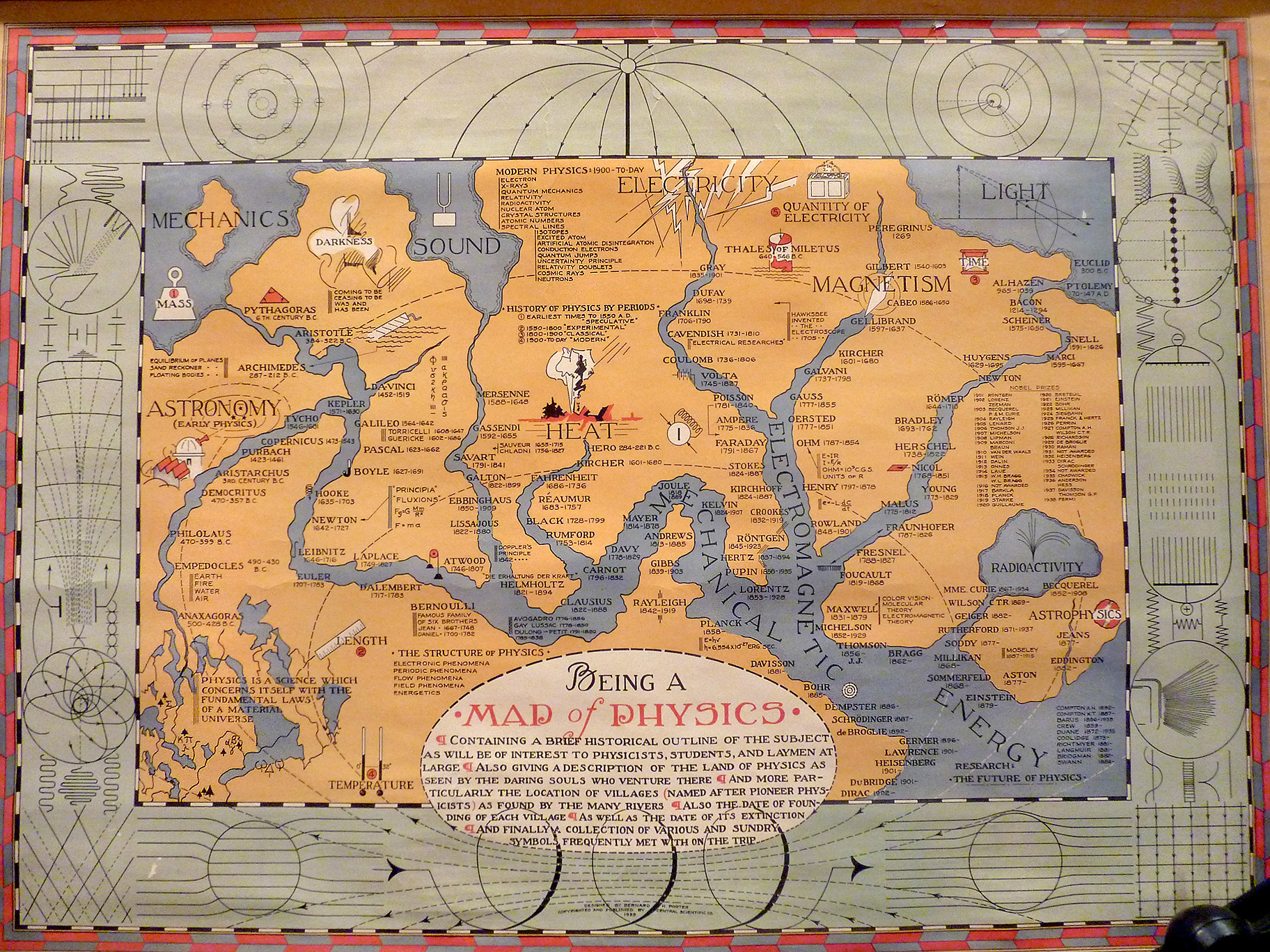
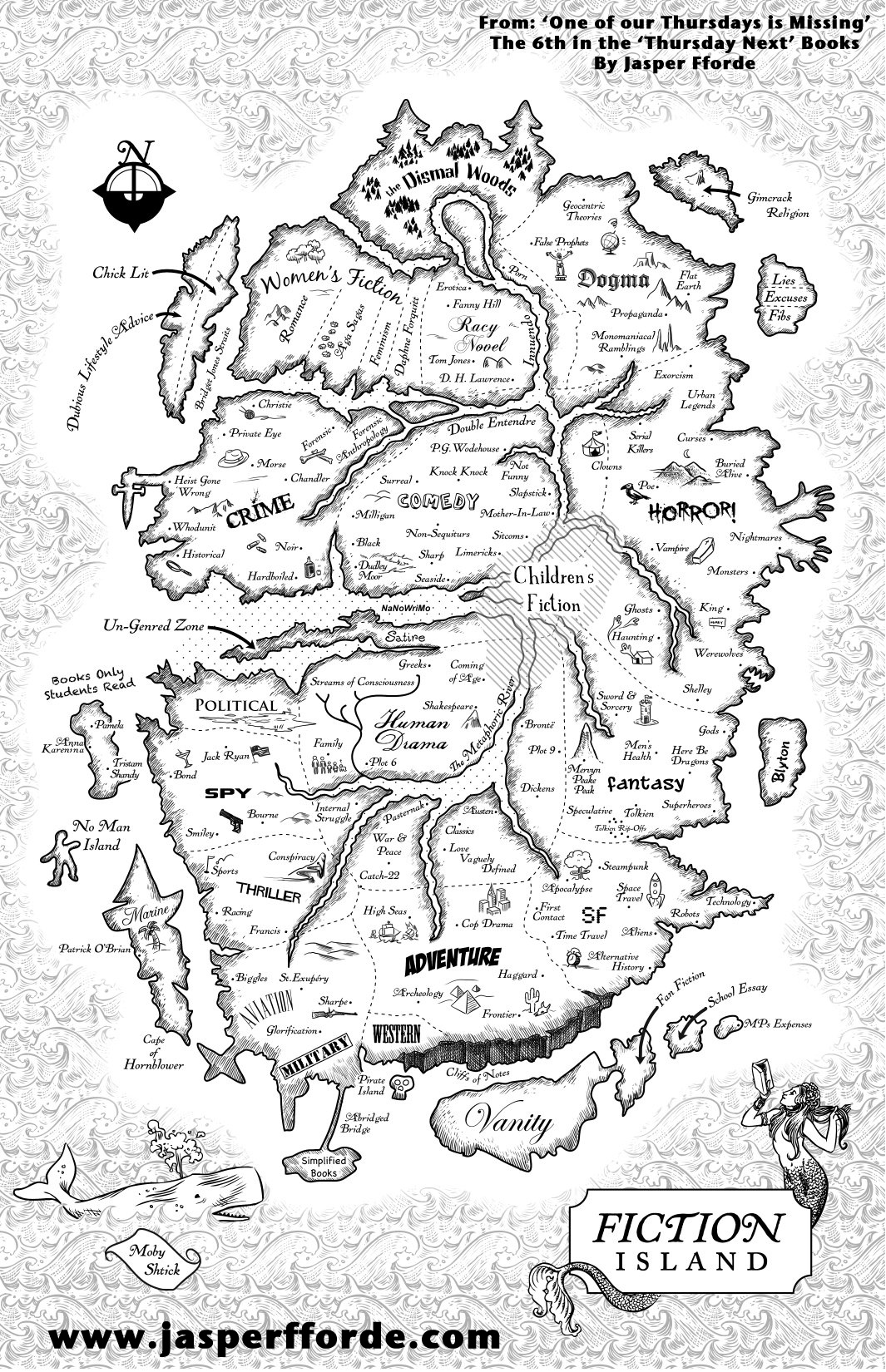
My two favorite subjects presented through maps:
Bernard H. Porter’s 1939 map depicting Physics as a continent, with rivers corresponding to its principal branches. From dabacon.org.
Fiction Island and a rough layout of the genres, from Jasper Fforde, 2011:
“Imagine for a moment what the general opinion will be fifty years from now if the name Einstein does not appear on the list of Nobel laureates.”
M. Brillouin, in a letter to the Swedish Academy of Sciences, 1921.
Albert Einstein was born on March 14, 1879, in Ulm, Germany. He studied at the Institute of Technology in Zurich, graduated with an undistinguished record, tried and failed to get a university job. A recommendation from a father of a friend helped Einstein to get a position at the Swiss Patent Office in Bern. 1905 was Einstein’s magic year. In that year (while working at the patent office), Einstein produced six papers:
E=mc2Late in 1906, Einstein became the founder of the quantum theory of the solid state, by giving the essentially correct explanation of the anomalous behavior of hard solids (such as diamonds) at low temperatures.
Between 1907 and 1911, Einstein focused his attention on the quantum theory. From 1911 to 1915 his main focus was formulating the general theory of relativity (which he published in November 1915).
(Summarized from Subtle is the Lord, the science and the life of Albert Einstein, by Abraham Pais).
American Institute of Physics has a brief Einstein’s Chronology. and also a more detailed account.
“ Einstein’s new general theory of relativity predicted a remarkable effect: when a ray of light passes near a massive body, the ray should be bent. For example, starlight passing near the sun should be slightly deflected by gravity. This deflection could be measured when the sun’s own light was blocked during an eclipse. Einstein predicted a specific amount of deflection, and the prediction spurred British astronomers to try to observe a total eclipse in May 1919 … The starlight had been deflected just as Einstein had predicted…
Announcement of the eclipse results caused a sensation, and not only among scientists. It brought home to the public a transformation of physics, by Einstein and others, that was overturning established views of time, space, matter, and energy. Einstein became the world’s symbol of the new physics. Some journalists took a perverse delight in exaggerating the incomprehensibility of his theory, claiming that only a genius could understand it. More serious thinkers — philosophers, artists, ordinary educated and curious people — took the trouble to study the new concepts. These people too chose Einstein as a symbol for thought at its highest. ”
Ready to check how much you know about Einstein?
Here are three statements. Only one is correct:
1. The celebrated relation E=mc2 is called Einstein’s equation.
2. Einstein received the Nobel prize for E=mc2.
3. Einstein called the “cosmological constant” he introduced, his largest blunder.
“With the slow fascination of fear, he lifted himself on one arm and turned his eyes toward the blood-curdling blackness of the window.
Through it shone the Stars!
Not Earth’s feeble thirty-six hundred Stars visible to the eye; Lagash was in the center of a giant cluster. Thirty thousand mighty suns shone down in a soul-searing splendor that was more frighteningly cold in its awful indifference than the bitter wind that shivered across the cold, horribly bleak world …
“Light!” he screamed.
Aton, somewhere, was crying, whimpering horribly like a terribly frightened child. “Stars – all the Stars – we didn’t know at all. We didn’t know anything.”
Nightfall, Isaac Asimov
On our Earth, we are so familiar with the little twinkling objects dotting the sky, that we hardly pause to ponder on what lurks in the cold, dark space. Shielded behind the atmosphere, we look at the starry night, without feeling threatened. Occasionally, we may find the sight romantic or inspiring.
For astronomers, the haze of the atmosphere is disturbing rather than comforting. In the early 1900s, when the astronomer G. E. Hale looked for a place where observations would be unfettered by cloudy weather and poor seeing conditions, he chose Mt. Wilson’s 5700 foot peak, which overlooked the relatively unpopulated cities of Los Angeles and Pasadena (www.aip.org/history). In the 1920s, Edwin Hubble, for whom the Hubble Space Telescope is named, used the largest telescope of his day at the Mt. Wilson Observatory to discover galaxies beyond our own. (More about Edwin Hubble at: www.spacetelescope.org).
Another solution to evade the effects of the atmosphere is placing the telescope in an orbit around the Earth. The Hubble Space Telescope was launched in 1990 on the space shuttle Discovery. Since then, it whirls at 17,500 mph along a circular earth orbit of 340 miles altitude. The telescope can observe astronomical objects with an angular size of 0.05 arc seconds, which is like seeing a pair of fireflies in Tokyo from Maryland. Since its mission began, the Hubble telescope has made more than 1 million observations and has captured images going back to very distant past, at locations more than 13.4 billion light years from Earth. It is considered one of the most productive scientific instruments ever built. (Text summarized from NASA)
“In celebration of its 25th anniversary, Hubble has revisited the famous pillars, providing astronomers with a sharper and wider view. As a bonus, the pillars have been photographed in near-infrared light, as well as visible light. The infrared view transforms the pillars into eerie, wispy silhouettes seen against a background of myriad stars. That’s because the infrared light penetrates much of the gas and dust, except for the densest regions of the pillars. Newborn stars can be seen hidden away inside the pillars.”
Text from hubblesite.org

Source: Hubblesite.org. See a large photo here
More of the telescope’s images are featured in this pdf file.
Visit hubble25th.org to vote for the best Hubble image.
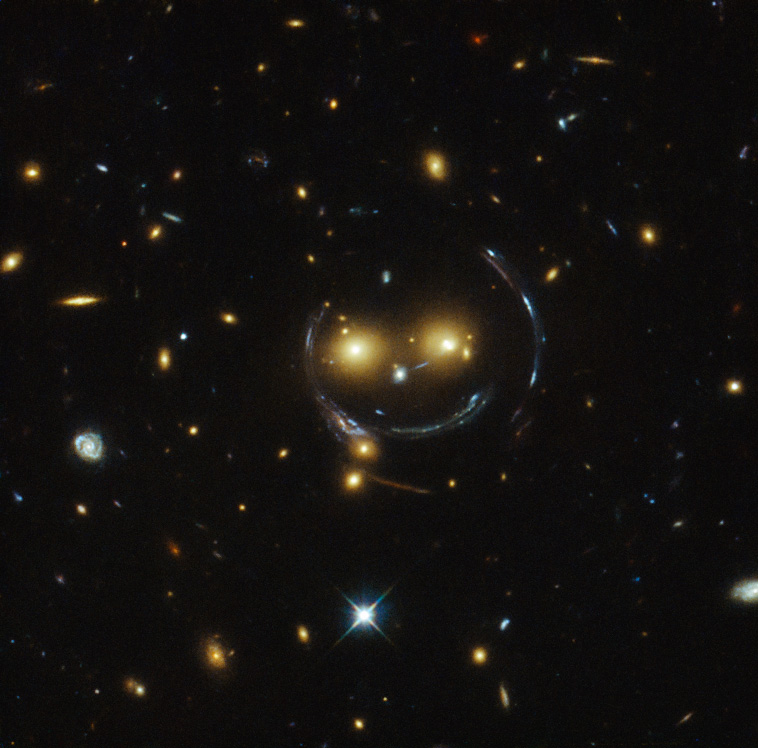
“You can make out two orange eyes and a white button nose. In the case of this “happy face”, the two eyes are the galaxies SDSSCGB 8842.3 and SDSSCGB 8842.4.”
From the ESA website for the Hubble space telescope.
The smile, however, is an optical illusion. The lines are actually arcs created by a galaxy cluster. Such phenomena occur when a very massive object (and galaxy clusters are the most massive objects in the universe) is located between the distant source of light and the observer. The object deflects the “incoming” light from its original path, thus acting like an enormous gravitational lens.
The smiling image is a special case of gravitational lensing, known as Einstein ring.
For a non-mathematical, beautifully illustrated explanation, see “Einstein Rings: Nature’s Gravitational Lenses” by Leonidas Moustakas and Adam Bolton. Here is a short version:
When light coming from a distant source (such as a galaxy) passes through a strong gravitational field (created, for example, by another galaxy), the light is deflected from its course. To an observer, that light appears “bent”, as if it passed through a lens. If the source galaxy, the “lens” and the observer (in this case the Hubble Space Telescope) are aligned almost perfectly along the same line, the light rays from the faraway source will be bent all around the lens, forming a full Einstein ring.
I thought that Einstein’s rings are called so simply because gravitational lensing stems from Einstein’s theory of General Relativity (which he published in 1915). In Einstein’s biography, Subtle is the Lord, Abraham Pais points that it was Isaac Newton who suggested that
“Bodies act upon Light at a distance, and by action bend its Rays.”
In 1801, the astronomer von Soldner calculated from astronomical data the scattering of light-particles by the Sun according to Newtonian scattering theory. Einstein, who did not know of von Soldner’s work, became aware that gravitation caused the bending of light in 1907. At that time, Einstein thought only of terrestrial experiments as a means of observation, and therefore concluded that these would be too hard to perform. By 1911, Einstein realized that deflection of light by the Sun could be detectable. The value he calculated was quite close to the one von Soldner found.
To form a gravitational lens, a distribution of matter (such as a cluster of galaxies) has to be located between a distant source and an observer. It acts like a lens, because its strong gravitational field bends the light from the source as it travels towards the observer.
According to Tilman Sauer (in A brief history of gravitational lensing):
“Einstein jotted down the basic properties of such a gravitational lens in one of his notebooks, presumably on the occasion of a visit to Berlin in April 1912… The notebook contains rough sketches as well as the basic formulae needed to describe the lens effect… At the time, Einstein must have concluded that the lens effect would not actually be observable. In fact, the angle between the two images depends on the mass of the lens object as well as the distances between source, lens mass and observer; it is exceedingly improbable for two stars to be aligned so precisely as to produce a double image observable from Earth.”
Orest Chwolson published a paper about the effect in 1924, but the concept did not receive much attention until Einstein published in 1936 a brief note on the subject, in the journal Science. In the note, Einstein presented formulae for the optical properties of a gravitational lens, which he had derived some 24 years earlier. After Einstein published, the topic was followed by a number of articles by well-known scientists.
According to Wikipedia, the first Einstein ring was discovered in 1988, and the first complete Einstein ring was discovered in 1998.
.


 T. K. Flor's Blog