
“You can ask him to stay, Jane—it’s not the same as a marriage proposal.”
“Are you sure? It’s a big move, and—I have no idea what is best for him, or for me…What do you think I should do?”
Anna gave Jane an incredulous look. “Are you kidding? I have no clue.”
Jane was grateful that Anna hadn’t presumed to have the answer. It wasn’t math; there wasn’t one correct solution.
This morning, staring at the blank page of her diary, she was musing about To thine own self be true again. What if one were sort of a mess…dyspeptic, surly, anhedonic? Why would you want to be true to that?”
From Mess: A Novel by Michael Chessler
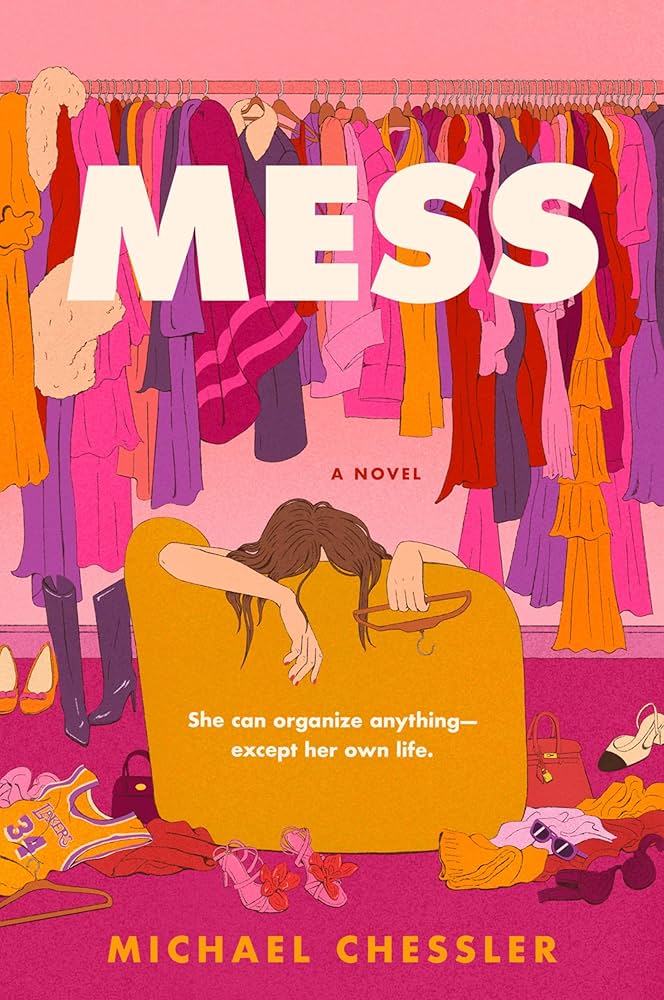 It took almost the entire book for Jane Brown, the protagonist of the novel MESS, to realize that it is not only the closets of her rich and glamorous clients that are filled with stuff they have no use for. Then, instead of showing a heroine’s qualities and luring back her wayward boyfriend, Jane turns to her best friend Anna for advice. Such vacillation may be understandable if Jane were a teenager, but not for a woman in her early thirties who has lived in Los Angeles since she had graduated from “an East Coast college with an endowment larger than the gross domestic product of many developing nations” with a degree in literature. Early in the story, the readers are told that Jane’s first job in LA was an assistant at one of the top TV and film talent agencies. She proceeded to the “development” world, where “most of what Jane read was dreck, and she soon realized that if she liked something, it was doomed.” A string of “insufferable” bosses left Jane disillusioned about her chances to achieve anything meaningful. She agonized over “futile and exhausting” compromises, but showed a knack for decluttering and “enjoyed creating order out of chaos.” At some point before the novel begins, the aforementioned boyfriend encouraged her to throw away her degree and switch careers, so with “jumbled feelings of regret and relief, of sadness and elation, Jane quit showbiz and started her own organizing business.”
The novel begins with Jane at work as a “professional organizer.” That day, she’s hired to cull an overstuffed closet of a dog with “two hundred thousand followers on Instagram.” The pay is good, but is it really a wonder that Jane represses her needs and emotions to keep doing this kind of job on a daily basis? Or that, faced with ridiculous excesses, she steals from her clueless clients, but only one item at a time, something they’d discard and never miss? Such antics could point to a socially aware, feisty and badass heroine, but the author defies the expectations created by the vibrant pink cover and sassy tagline: She can organize everything—except her own life. Jane comes across as a cynical and overly judgmental automaton, on one hand haughty and pretentious, but on the other hand disillusioned and resentful. She is healthy, attractive and has a good mind, yet all she sees around is stupidity and shallowness. All she does is drive around LA’s posh neighborhoods to organize and discard other people’s belongings. On the face of it, she could have worked on her own script, and joined a literary group where her fancy degree and extensive vocabulary might have been appreciated. But Jane is a romantic caught between a rock and a hard place: she is certain that nothing worthwhile can succeed in Hollywood, but being a perfectionist, she chooses to repress her own creativity over making crap. Jane is good at what she does, but there is no contentment on the horizon. Meanwhile, Jane squanders her free time on fretting over her weight and finding faults in her boyfriend, her mother, her co-workers and the wealthy people she works for.
So how could I enjoy a novel about this negativity-oozing woman? My guess is that I’m tired of the cookie-cutter romantic heroines, who overcome abuse, childhood trauma, and whatnot to become witty and fun-loving adults, a cohort of strong women who transform broody and self-centered stars/dukes/billionaires into prime husband material. Jane is their opposite. She’s stiff and detached, and so critical she drives away the man she loves. And yes, it’s annoying that Jane criticizes her and others’ shortcomings ad nauseam and flaunts her taste and vocabulary. But it is refreshing to read about a female protagonist who “could look over someone’s closet and compile a dossier worthy of the CIA.” Jane is judgmental, but she also learns from her experiences at the houses she works at. She is unlikable, but she is not a moron, and I respected her for refusing to settle on less than what she believes is her due.
It’s hard to find books with protagonists of different personality types, who do not blindly follow the expected “hero’s journey.” MESS is particularly gratifying because the author is a Hollywood pro, who could have sugarcoated his experiences in the industry to feed his readers with a saccharine fairy tale worthy of thousands of five stars on Goodreads. I appreciate that he created a heroine no less complex and intriguing than male protagonists, a woman allowed to think for herself, to brood, and to stubbornly—albeit not always wisely—choose a path that does not compromise her needs and her ideals.
I recommend this book to those who like to meet a cynical woman who takes her time to realize what is obvious to readers from the get go.