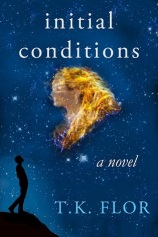
A review as a “thank you”

When I read a new book, what happens to fictional people inhabiting an imaginary world might grip me for hours. Quite rarely, some of the characters linger in my mind for days, or pop in unexpectedly weeks after I reached “The End”. The author who created that world, on the other hand, remains a detached name on the cover. Regardless of whether she is a famous storyteller or he is someone I’ve never heard of before, it wouldn’t occur to me to thank the author for my reading experience. Moreover, if an idea to rave to about the book to strangers sneaks into my mind, I’ll shrug it off. No one asked for my opinion, so writing a review is at best self-indulgent. And frankly, who cares about my 2 cents?
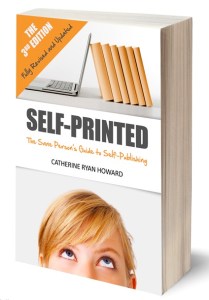
Well, one of the sections in SELF-PRINTED (3rd edition) by Catherine Ryan Howard, caused me to think again about reviewing a book that I’ve enjoyed.

“Thing is,” Catherine writes, “reviews are very important to self published books; much more so than they are to their traditionally published counterparts. With no editor or agent to vet the quality of the work, the potential customer has to look elsewhere for promises of quality.”
Since I don’t consider myself as qualified to reassure others about the quality of a literary work, I didn’t dwell on this passage, but a few pages later, I read more about reviews:

One of the nicest things about having a book out there in the world is opening your e-mail account and discovering messages from readers in far off lands, telling you how much they loved your book. Now I have no idea how many of these messages I’ve got, but I can tell you this for a fact: it’s a hell of a lot more than I’ve got Amazon reviews. Now I love those e-mails – I print them out and file them in a Break Open in Case of Loss of Confidence in Writing Emergency – but I sometimes wonder, if these people love my book so much and they took the time to e-mail me about it, why don’t they take five minutes to give it an Amazon review and tell everyone else? As I’ve already said, Amazon reviews are so important to self-published authors, I can’t stress it enough.

As a reader I understand why one prefers to contact an author directly (an email is personal – I can put there stuff that resonated with me but not intended for the public eye), rather than leave the praise on the unrelentingly cold medium of Amazon. However, after I read Catherine’s self-publishing book, and saw similar arguments about the importance of reviews in David Gaughran’s blog, I understand why an author would appreciate my “thank you” more if it’d be displayed where those considering buying the book could see it. A self-published author, who produces a book on a par with a publishing house, has to invest a lot of time and go into considerable expenses after the storytelling part is completed (there is no one else to pay for professional cover, editing, proofreading, etc.). Then, after the ebook/paperback goes into the world, there is no professional marketing department to promote the self-published book, and no brick-and-mortar stores where a customer can discover it. So if the book really stood out, a nice way to thank the author is to praise the book where it can be seen by potential buyers (on whom the author’s career depends).
Posted in fiction, self-publishing | Tagged , , | 1 Comment

Self-publishing a mainstream novel – Q&A with Catherine Ryan Howard

Catherine, in her own words, is “a writer, self-publisher and caffeine enthusiast from Cork, Ireland.” THE SANE PERSON'S GUIDE TO SELF-PUBLISHING
I first saw Catherine’s blog, ‘Catherine, Caffeinated‘,
in the summer, when I was starting to explore the option of self publishing. To promote her new book,
SELF-PRINTED: THE SANE PERSON’S GUIDE TO SELF-PUBLISHING (3rd edition),
Catherine invited bloggers, twitters, and Facebook page-owners to present her with a question about self-publishing, that she’d answer (along with an offer to receive a digital copy of Self-Printed 3.0). The following is my question, and Catherine’s answer.


Q: I intend to self-publish a mainstream contemporary novel. On the Internet, most of the information about discoverability of self-published books and e-books pertains to genre fiction (e.g. romance/thrillers/science-fiction/fantasy/YA). The rest falls under the large umbrella of ‘literary & fiction’, with subdivisions for historical/literary/women’s fiction. ‘Mainstream fiction’, however, falls between the cracks of this genre-oriented system.
What is your advice for making a self-published mainstream novel visible?

A: I have to be blunt and say I just don’t believe there’s any book that can’t be shoehorned into a category or genre for promotional sake, but that’s an argument for another day…

Your point is that most of the advice you find online is orientated towards genres of fiction that are not yours (and we’ll agree to disagree on why they’re not yours). But here’s all your have to do to start to promote your book online: find readers who are predisposed to liking it because they like something else that was similar. This “something else” doesn’t have to be a genre – it can be a single book. So let’s say you’ve written the next To Rise Again at a Decent Hour. That’s a book that’s difficult to categorize into a specific genre, and book bloggers who love crime and Goodreads groups dedicated to steampunk are going to be of no use to you. So I would think of another book that is (a) similar to yours, (b) was published recently and (c) sold well, ideally hit the bestseller lists. Let’s say sake of argument that we came up with The Bone Clocks by David Mitchell.

Now I would:

1. Look up The Bone Clocks on Amazon and make a list of the titles that appear in “Customers Also Bought”. Going forward we’re going to rely on as many of those titles as we think are relevant, plus The Bone Clocks

2. Find the book’s Goodreads page and contact the users who gave it 5* and are accepting messages. (You can send private messages to non-friends but they are limited to I think around 12 a day). Offer them a complimentary copy of your book to review. Set up a Goodreads giveaway while you’re at it.

3. Google the titles along with the word “review”. The first couple of pages of results will be newspapers and magazines, but keep going and you’ll get to the book bloggers who reviewed them. Contact them re: reviewing your book.

4. A KDP Select free promotion is a great way to get people to take a chance on your book AND to entice readers directly. Genre/category won’t matter here – the zero price will attract all.

5. Genre/category won’t matter on Twitter either. Use PicMonkey.com or Canva.com to make up some attractive Twitter graphics (look in publishing houses’ Twitter feeds for great examples) and run a giveaway for a day where entry is by retweeting and following. Hopefully by now you have a nice quote from a blogger about your book to add to the graphic, and when people look up the book on Amazon they’ll see a great sales rank and reviews, or lots of 5* ratings on Goodreads. What little genre cubbyhole your book does or doesn’t fit into has ceased to matter.


Posted in fiction, mainstream fiction, self-publishing | Tagged , , , , , , | 3 Comments

The Falling Sky – contemporary fiction with realistic physics

Falling_Sky_170x176.2701

‘Do you believe it?’
Ah, that word again. It sounds odd in this space. They are all used to statistical odds, experiment, proof, even uncertainty, but they rarely talk about belief. It sounds too human. And they like to pretend that what they do is beyond human.
She looks at this man, whom she doesn’t know, and wonders what he thinks. She pauses before she speaks, because she knows this is important. It’s one thing to present an odd result, a peculiar image. It’s another thing entirely to have to explain your worldview. And she wants to get this right.

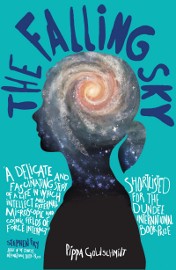
 The Falling Sky, Pippa Goldshmidt

This snippet in a part of a scene at a conference on cosmology, where Jeanette (the protagonist of The Falling Sky) presents a sensational astronomical observation. Like many other scenes in the novel, it brings to life physicists, their agendas, convictions and prejudices.

Since physics and physicists rarely have a pivotal role in fiction (other than in science-fiction), I expect that one would want to know whether the novel illuminates the importance of physics. Considering the emphasis given in the last decade to promoting women scientists, one might also be curious whether the novel emphasizes the role of women in physics’ advancement?

Pippa Goldschmidt addresses the relevance of astronomy and cosmology. She gives an honest answer of someone who knows thoroughly the field, yet does not depend on grants and her peers’ affirmation (any details would be spoilers, but the author’s wry outlook shines through the twists and turns of the story).

As to the second question, well, Jeanette Smith is definitely not a poster girl who would draw young women into science. She reminds me more of Stephen King’s Carrie, rather than Isaac Asimov’s legendary Susan Kelvin. Jeanette is troubled, she is self-doubting, and she is the most REAL lead female physicist I’ve met in fiction.

Do I recommend this book?
In short, yes.
The physics is sparse – explanations are short and appear when they are needed. Some familiarity with the basics of the Big Bang theory will add to the understanding of what the characters are discussing, and what are their dilemmas. The academic life is portrayed vividly, and with a healthy dose of humor. You won’t meet Nobel laureates or scientific celebrities (aside from Hawking, who makes a cameo appearance in his wheelchair). Jeanette and her colleagues are mostly young scientists, who struggle to promote their careers. Competition is tough, and arms and poison are out-of-question, so these bright and ambitious researchers have to find other means to get ahead.

Posted in Big Bang, cosmology, fiction, literature, physics | Tagged , , , , , | 2 Comments

How many Higgs fields might be on a head of a pin?

If you have a moment to spare, try a word association game with the word “field”. You might think of words as different as battle, baseball, oil, and strawberries. Now, if a physicist played the game, he (and occasionally she) might come with electrical, gravitational, quantum theory, or some other unusual word.

I was asked whether ‘Higgs field’ is countable (i.e. when a word’s plural and singular forms make sense, and that it is not a mass noun). That question made me realize that it is not always clear what physicists mean when they use the word “field”. Looking for a precise yet non-mathematical explanation, I found in the famous Feynman Lectures on Physics, that a “field” is a “condition” in space. Specifically, Feynman used the concept of a field to explain how positively and negatively charged particles interact:

…the existence of the positive charge, in some sense, distorts, or creates a “condition” in space, so that when we put the negative charge in, it feels a force. This potentiality for producing a force is called an electric field. When we put an electron in an electric field, we say it is “pulled.”

If the explanation seems straightforward, be assured that the notion of field muddles when one approaches the realm of quantum field theories. The electromagnetic field, for example, becomes in some instances a photon. But particles and fields are NOT interchangeable. It required the LHC (the largest particle accelerator in the world) to very briefly generate the Higgs Boson, even though the Higgs field permeates the space. To see a nice illustration of what a field is, and how it is represented, click on a short video published by Scientific American on YouTube.

Back to the question. The particle physics Standard Model has one Higgs field, but there are extensions of the model with more than one Higgs field, so the answer to the question whether ‘Higgs field’ is countable is… inconclusive.

Posted in physics | Tagged , , , , | Leave a comment

New York, New York

Manhattan, on a sunny August day.

Music, please…

P21

P27

P29

P79

Posted in photos | Tagged , , , | Leave a comment

Particle Fever – How many views would it get on YouTube?

Particle Fever is a documentary film about physicists’ search for the Higgs boson.
Official site, Trailer on YouTube:


The movie trails milestones in the launching of the Large Hadron Collider at CERN, shows some nerve-wrecking moments, and celebrates the triumph at the end. Along the story of the largest machine ever built by humankind, the film also brings personal stories of theorists (all of them men) and of experimentalists working at CERN (I was surprised to see and hear some women).

Critics generally loved the documentary. Out of about 500 hours of footage came 99 minutes of a fast-moving movie (as described on PBS), with awe-inspiring shoots inside the gigantic machine and without dwelling on technical aspects or being pedagogical about theoretical problems. When the camera does a close up on Peter Higgs, as he watches the announcement that confirms the discovery of a Higgs-like particle, one cannot remain untouched.

I enjoyed watching this movie, and I want to recommend it. The question is to whom?
Physicists, their significant others, their parents, children, best friends, the readers of quantum diaries, and… (you get the gist) have already heard about the movie. Others might remember hearing about the discovery of the Higgs boson or “the God’s particle” in the news, but that was over two years ago.

So, what shall I say to entice prospective watchers?
The quest after the Higgs boson could be seen as a modern take on the King Arthur’s knights questing after the Holy Grail. The modern quest is uplifting, for those interested in what the quest aimed to accomplish. Otherwise, it’s a story without an adversary, a movie without conflict, a documentary about physicists wasting billions of dollars to check outlandish theories. Since so much has been said and written about the discovery of the Higgs boson, there is little point in adding my two cents. Instead, let me cite from the Nobel prize in Physics 2013 award:

François Englert and Peter W. Higgs are jointly awarded the Nobel Prize in Physics 2013 for the theory of how particles acquire mass. In 1964, they proposed the theory independently of each other (Englert together with his now deceased colleague Robert Brout). In 2012, their ideas were confirmed by the discovery of a so called Higgs particle at the CERN laboratory outside Geneva in Switzerland.

The awarded mechanism is a central part of the Standard Model of particle physics that describes how the world is constructed. According to the Standard Model, everything, from flowers and people to stars and planets, consists of just a few building blocks: matter particles. These particles are governed by forces mediated by force particles that make sure everything works as it should.

The entire Standard Model also rests on the existence of a special kind of particle: the Higgs particle. It is connected to an invisible field that fills up all space. Even when our universe seems empty, this field is there. Had it not been there, electrons and quarks would be mass-less just like photons, the light particles. And like photons they would, just as Einstein’s theory predicts, rush through space at the speed of light, without any possibility to get caught in atoms or molecules. Nothing of what we know, not even we, would exist.


PS The movie trailer has been watched on YouTube about half a million times (as of Aug.24, 2014).

Posted in movies, physics | Tagged , , | Leave a comment

Literature vs. Disruptive technology

The epic verbal battle of the summer belongs to the much publicized negotiations between Hachette and Amazon. Megastars like Stephen King and Nora Roberts, battalions of indie authors, publishers of every size, and even the New York Times chimed in with their take on which corporation is the “bad guy”. Among the many words tossed into the fray, the words “literature” and “disruptive technology” seem to sum up what each side ‘stands for’ (see this blog for more on the ongoing dispute). The supporters of the big publisher are fighting under the banner of championing literature, and of protecting it from the soulless efficiency of technology. The fans of the giant tech retailer point to the fate of newspapers, records, scrolls, etc., as the writing on the wall. Stagnated industries, they argue, are bound to give way to cheaper and faster technological innovations.

Is there anything else to say about the dichotomy between “literature” and “disruptive technology”?

“Oh, yes,” said Dr. Phineas Welch, “I can bring back the spirits of the illustrious dead.”

He was a little drunk, or maybe he wouldn’t have said it. Of course, it was perfectly all right to get a little drunk at the annual Christmas party.

Scott Robertson, the school’s young English instructor, adjusted his glasses and looked to right and left to see if they were overheard. “Really, Dr. Welch.”

“I mean it. And not just the spirits. I bring back the bodies too.”

To anyone who cannot recall how the conversation between the young English literature instructor (Scott Robertson) and the physics professor (Dr. Welch) ended, I suggest to read, or reread, The Immortal Bard by Isaac Asimov. (For those interested in only the facts and willing to forgo the fun, here is the plot summary).

Why did I bring up the story?

To me it illustrates how firmly our perceptions are rooted in our environment’s common wisdom. The young English professor “knows” that time-traveling is impossible. And of course, his position entails him to know what Shakespeare meant in his plays. For him, everything is conveniently pigeonholed.

The physics professor comes across as a superior being, the one who possesses a groundbreaking technology. Yet, the arrogant and know-it-all physicist repeatedly uses the technology to disrupt other people’s life. Moreover, he misses a great opportunity, simply by not consulting with the English professor.

A morale from the story? My take is that “literature” guys would better open up to what the rest of the world is doing. “Tech” guys, on the other hand, may take a break from their endless pursuit of innovation, and use the time to contemplate the actual cost of their actions. Corporations are often portrayed as incapable of taking into account anything but monetary gains. If they don’t want to follow the two blockheads in Asimov’s story, they would seize the opportunity to look for an innovative, viable solution.

PS.
On a second thought, Asimov’s The Immortal Bard is also highly recommended for middle- and high-school students in the throes of Language Arts summer assignments. Its shortness and irreverent humor might cheer them up.

Posted in disruptive technology, literature | Tagged , , | Leave a comment

Fiction, Physics, and BBC

“You just won’t believe how vastly, hugely, mind-bogglingly big space is,” said the author Douglas Adams. This citation from The Hitchhiker’s Guide to The Galaxy opens the BBC’s animated guide to “Big Bang: How the Universe was created” . The tone of presentation is lighthearted, the animation is eye-catching and witty. The idea of filling the Royal Albert Hall with frozen peas is undeniably cute. A text-book example of a brilliant combination of fiction and physics? Maybe.

The narrator mentions Hubble’s discovery of the expansion of the Universe, the theoretical prediction that the universe is filled with free-streaming background radiation (made by Alpher, Gamow and Herman), and the accidental discovery of the Cosmic Microwave Background Radiation by Arno Penzias and Robert Wilson. Then the narrator continues with the following statement:

“Around 13.8 billion years ago, all the matter in the Universe emerged from a single, minute point, or singularity, in a violent burst.”

Is this statement right? Or maybe, “It is not even wrong”?

For a comprehensive, but pretty long answer see e.g.:http://map.gsfc.nasa.gov/universe/. In a nutshell, modern cosmology (a science based on a plethora of observations interpreted within the framework of Einstein’s theory of General Relativity) favors the notion that the Universe is infinite. In such a case, the universe has emerged infinite and was not born from a single point. The violent burst at the beginning was way more mind-boggling than the narrator suggests – it happened not at one point but everywhere in the universe!

Here is how the Big Bang primer at NASA cautions against a simplistic interpretation:

Please keep in mind the following important points to avoid misconceptions about the Big Bang and expansion:

  • The Big Bang did not occur at a single point in space as an “explosion.” It is better thought of as the simultaneous appearance of space everywhere in the universe. That region of space that is within our present horizon was indeed no bigger than a point in the past. Nevertheless, if all of space both inside and outside our horizon is infinite now, it was born infinite. …
Posted in Big Bang | Tagged , | Leave a comment

Welcome

Hi and welcome to my blog!

I was asked today what does the illustration on the banner of the blog mean.

The short answer – it’s a brief history of our universe.

The “Timeline of the Universe Image” by NASA/WAMP Science Team shows pivotal events in universe’s history, from the Big Bang (the glaring light at the left) to nowadays (the spacecraft at the right). The thimble-like shape illustrates the expansion of universe for over 13 billion years. The closed side depicts the universe’s mind-boggling growth at its very beginning. The area dotted with specs of light in the middle illustrates the formation of stars, galaxies, and so on, during a period when the universe went through its “middle age”. After a long stretch of slowing expansion, the “thimble” started to open-up – the universe has reached the modern-era of accelerated expansion. Coincidentally or not, the time span of the latest epoch coincides more or less with the age of our Earth.

You can see the image with explanations at: http://wmap.gsfc.nasa.gov/media/060915/ . NASA also offers a 3D rotating image of WAMP spacecraft at: http://wmap.gsfc.nasa.gov/resources/wmapsc.html.

Posted in Uncategorized | Tagged , | Leave a comment

What is The Hungry Boson?

Write your guesses!

Update: See answer on The Hungry Boson

Posted in Uncategorized | Leave a comment