
“I wanted to throw my whole self into writing, believing I could make a go of it, while simultaneously doubting it was possible. I’d reached one of those edges, when you can’t fathom remaining where you are, but neither can you imagine going forward.”
From WRITING CREATIVITY AND SOUL, a book by Sue Monk Kidd.
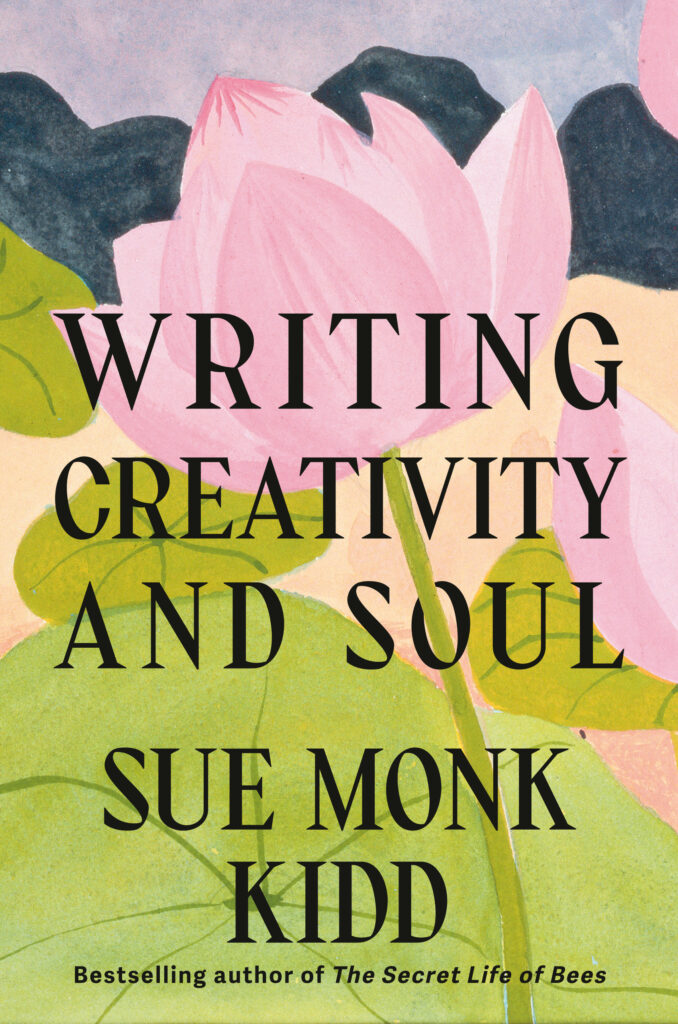 WRITING CREATIVITY AND SOUL is partly a memoir of Sue Monk Kidd’s long and rewarding writer’s journey, and partly an introspection about the inner forces that compelled her to write and about the external forces that shaped her writing.
“Geography is fate,” Sue Monk Kidd (SMK) cites Heraclitus, adding “This was true of me.” Her writing odyssey began with a clash between her “impulse of the heart” to write and the societal expectations of “the pre-feminist, pre-civil rights, religion-possessed South,” where a girl from her background went to a charm school to polish her manners and studied in an all-girl home economics class how to cook, sew, entertain, please her husband and raise their children. At fifteen, Sue was certain that she meant to be a writer; after high school, she studied nursing in college, married and began a family.
Finding the light, then losing the light—it happens to writers all the time. Circumstances intervene that extinguish it, or the radiance flickers out from lack of attention or a belief that we aren’t capable enough. John Gardener suggested that the true search in a writer’s life is for “the necessary fire.” I believe he meant that the writer must search for a conviction in herself, for the place of combustion inside that enables her to say with certitude, This is my path.
SMK believed in herself, yet as a mother of two young children who juggled writing with night shifts at hospital, she realized that while keeping all the balls in the air, she basically gave up on her dream. Longing to reclaim the creativity she had felt in her youth, and having a supportive husband who was willing to make financial adjustments, she left nursing to write full-time. In stories, taking the leap starts an alchemical chain of events that transforms a heroine into a much better version of herself. In real life, it took more than dedication and having time to write to alleviate the self-doubts of a woman discouraged to believe in her abilities. The memoir discusses other ingredients that made a difference. For me, the most interesting one is creativity.
The book starts with a premise that creativity is an instinct that seeks conscious expression in the world, and proceeds to Jung’s distinction between writing that originates from the unconscious (“the deep inner world of the author”) and writing that draws from the “conscious mind and rational intellect.” Creativity has an unconscious part where stories are conceived, and a focused, goal-oriented one that brings order to and shapes the disconnected figments of imagination. Both are necessary for writing.
The unconscious “mystery beneath the words” that writers sometime call the Muse generates images, conjures dreams, and creates epiphanies when one is stuck in their work. Although it’s impossible to summon inspiration, the Muse’s appearance is not completely unpredictable. Good work habits, motivation, and routine are oft-quoted suggestions to train her to show up. To these, SMK adds taking time from actively looking for a solution, and cites Einstein who made breakthroughs while not being actively engaged in productive work. Apparently, an indolent mind frees our imagination to browse around, to find new connections and discover meaning that eludes us when we are focused on coming up with results. Subconscious creativity, however, cannot create tangible work. Ideas are like seeds, or possibilities; merely combining figments of imagination generates chaos rather than art.
“In literature,” she cites a writing teacher, “madness uncontrolled is madness, madness controlled is genius.” Achieving such control while crafting stories that resonate with readers is both art and craft.
The book’s largest section is on the craft of writing. Those who have read other books on the subject would be familiar with most of the content, but any novice who believes that having a story to tell is the most important part of the process is bound to be disillusioned. I especially liked SMK’s description of the bored reader in the chapter “Hurry Slowly.” A passenger on a cross-country flight does not care how action is paced with explorations of the characters and with world-building, or whether the story is imbued with meaning. All she notes is that “This thing is so-o-o slow.”
The last section of WRITING CREATIVITY AND SOUL is about meaning. In this part, I discovered the work of Mihaly Csikszentmihalyi, a psychologist who studied creativity and a phenomenon he called “flow.” I have encountered the term in craft books and in podcasts about writing, but SMK’s introduction caused me to want to know more about this blissful “state in which people are so involved in an activity that nothing else seems to matter; the experience is so enjoyable that people will continue to do it even at great cost, for the sheer sake of doing it.” (from https://news.uchicago.edu/story/mihaly-csikszentmihalyi-pioneering-psychologist-and-father-flow-1934-2021)
I recommend WRITING CREATIVITY AND SOUL to readers interested in an introspective view on the “heart and soul” and the craft of writing, and to writers tempted to substitute chunks of lengthy and often unpredictable process with AI-generated text based on their ideas. As Sue Monk Kidd shows, writing is more than ideas and craft. It offers and requires creativity and self-discovery.

 T. K. Flor's Blog