
“It is my life’s work to tell stories,” the bard continued, his smile gone now and replaced with an earnest tone. “And no one else can tell you what I have seen. This great war of our time has indeed been terrible, and I am still struck with its horrors, waking up in the night sweating and—well, I am sure I don’t have to tell you.”
From A Plague of Giants, a novel by Kevin Hearne.
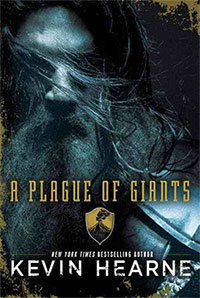 When a book opens with a bard addressing refugees gathered at a place called Survival Field, I can either assume that the book is rife with death and gore and return it unread to the library, or assume that in this horrible situation the bard has something comforting to say to people already devastated by loss of their families and homes. Curious about the direction A Plague of Giants would take, I decided to give it a try. A Plague of Giants is a high-fantasy about 600 pages long, with eleven main characters. In my mind, long sagas with bards and mythical elements belong to ancient Greece and medieval Europe, whereas modern fiction is usually shorter and with fewer protagonists.* In novels I’ve read, main characters, even if they are scattered in different places and belong to different cultures, ARE UNITED by a main goal or event.
The beginning was not promising. I struggled to remember who is who and where different places are (there is a Dramatis Personae and a map, but flipping pages to check this or that was not conducive for immersing in the story). Even worse, the skeleton-like Bone Giants, whose deadly invasion on the eastern shores of the continent started the war, were a faceless, merciless evil without a glimmer of humanity. I did not want to know more about them. I continued to read because Hearne’s storytelling is engaging, the world-building is rich without being overly descriptive, and the magic is nuanced and intriguing. As the bard’s tale progressed, the Bone Giants’ thread turned out to be one of three. The other threads drew me to continue reading the story.
The Hathrim are fire-wielding giants (unrelated to Bone Giants) who settled without permission on a piece of land on the west coast of the continent. Strictly speaking, they’re trespassers, yet they are actual people with names, families, and human emotions. Most importantly, they did not sail to another country with the purpose to kill and conquer. They fled a volcanic eruption that made their island uninhabitable. Their ferocious and cunning Hearthfire (I think that’s their word for chieftain) made the most of the bad situation, and led the surviving Hathrim to a new place. Through a combination of physical strength, magic and deceit they occupied an uninhabited stretch of land and began to make it their home. Naturally, the local peoples took notice. Some wanted the newcomers to leave out of sheer nastiness. Others, mainly the plant-magic users of Forn, perceived a large settlement of giants armed with the destructive power of fire as a threat they could not accept.
The third thread is a tale of coming of age that seemed totally unrelated to any giants. In a country believed to be devoid of magic, a teenager decided to go against his family’s tradition and do everything differently. There was nothing world-shattering about the lad’s choice to inform his domineering father about his decision at the worst possible timing. However, the ramifications of a commonplace confrontation were unpredictable when untapped magic was involved.
Gradually, the disconnected tidbits about the war, various forms of magic and personal growth came together, and I could not put the book down. I enjoyed how the threads in A Plague of Giants were interwoven, how events followed “naturally” from previous ones, how magic was not an inborn trait of a few “chosen ones”. In this world, magic is a potential individuals choose to seek at a risk of their life. My only complaint is that this book ends abruptly on day nineteen of the bard’s tale, with one liner, “Continued in volume two, A Blight of Blackwings.”
* Obviously, I do not read much high fantasy, but I plowed through Lord of the Rings.


 T. K. Flor's Blog